
High-Mileage Driving in the UAE: How to Get the Most Kilometres From Your Tyres

For most drivers, tyres are something to deal with every few years. If you drive for a living, ride-hailing, deliveries, a sales territory, or you simply commute between emirates every day, they are a running cost like fuel, and the difference between a set that lasts and a set that does not shows up in your monthly numbers.
The good news is that tyre life is decided far more by habits than by luck. This guide covers the habits that matter most, the service intervals the tyre makers themselves publish, and how to compare tyres by what they cost per kilometre rather than per tyre.
Think in cost per kilometre
The price of a tyre only tells you half the story. The number that matters to a high-mileage driver is the price divided by the kilometres of useful life. For illustration only: a tyre that costs AED 300 and gives 40,000 km costs 0.75 fils per kilometre, while one that costs AED 220 and gives 25,000 km costs 0.88 fils. The cheaper tyre is the more expensive one to run.
Nobody can promise you a mileage figure in advance, because the same tyre can last twice as long on one car as on another. That is why the habits below matter more than any brochure claim, and why it is worth choosing a tyre whose maker says it was designed for long life, then looking after it.
Pressure: the biggest single factor
An under-inflated tyre flexes more, runs hotter and wears its shoulders; an over-inflated one wears its centre. Laufenn's own care guide puts it simply: check the pressure every month, cold, at least three hours after driving, against the figure on the car's placard and never against the maximum moulded on the sidewall, because tyres "have been known to lose up to one psi in a month". In UAE heat, and on a car that is rarely parked for long, that monthly check is the most valuable five minutes you can spend. Our guide to tyre pressure in the UAE heat explains why the petrol-station gauge reads high in the afternoon.
Nitrogen filling is free with tyres bought from us. It does not replace the monthly check, but nitrogen holds its pressure a little more steadily; our nitrogen versus air guide covers what it does and does not do.
Rotation and alignment: the two services that pay for themselves
Front and rear tyres wear differently, so moving them around evens the wear and lets the set finish together. Laufenn's guidance is to rotate every six months or every 10,000 km. For a high-mileage car that can mean every few months, and with tyres bought from GCCO rotation every 10,000 km is free at any of our branches. Our guide to how often to rotate tyres covers the patterns.
Alignment matters even more, because a car that is out of alignment scrubs rubber off with every kilometre. Laufenn recommends an alignment check every year or every 20,000 km, and also after an accident or a hard kerb strike, after fitting new tyres, when one shoulder is wearing faster than the other, or when the steering wheel feels unsteady or vibrates. Some newer tyres help you spot it: the Laufenn S FIT2 carries an uneven-wear indicator that the maker says helps detect alignment problems early. Our guides to alignment and balancing and to reading wear patterns show what to look for.
Driving style and load
Hard acceleration, late braking and fast cornering all spend tread, and on a car that covers big distances the habit compounds. So does load: a delivery car that is always full, or a family car carrying seven, needs tyres whose load index matches the placard, at the pressure the placard gives for a loaded car if it lists one. Our guide to speed and load ratings explains the numbers. Kerbs are the other quiet killer: a sidewall scuffed every time the car is parked eventually cracks or bulges, and our sidewall damage guide shows which damage can wait and which cannot.
Replace on time, not too early and not too late
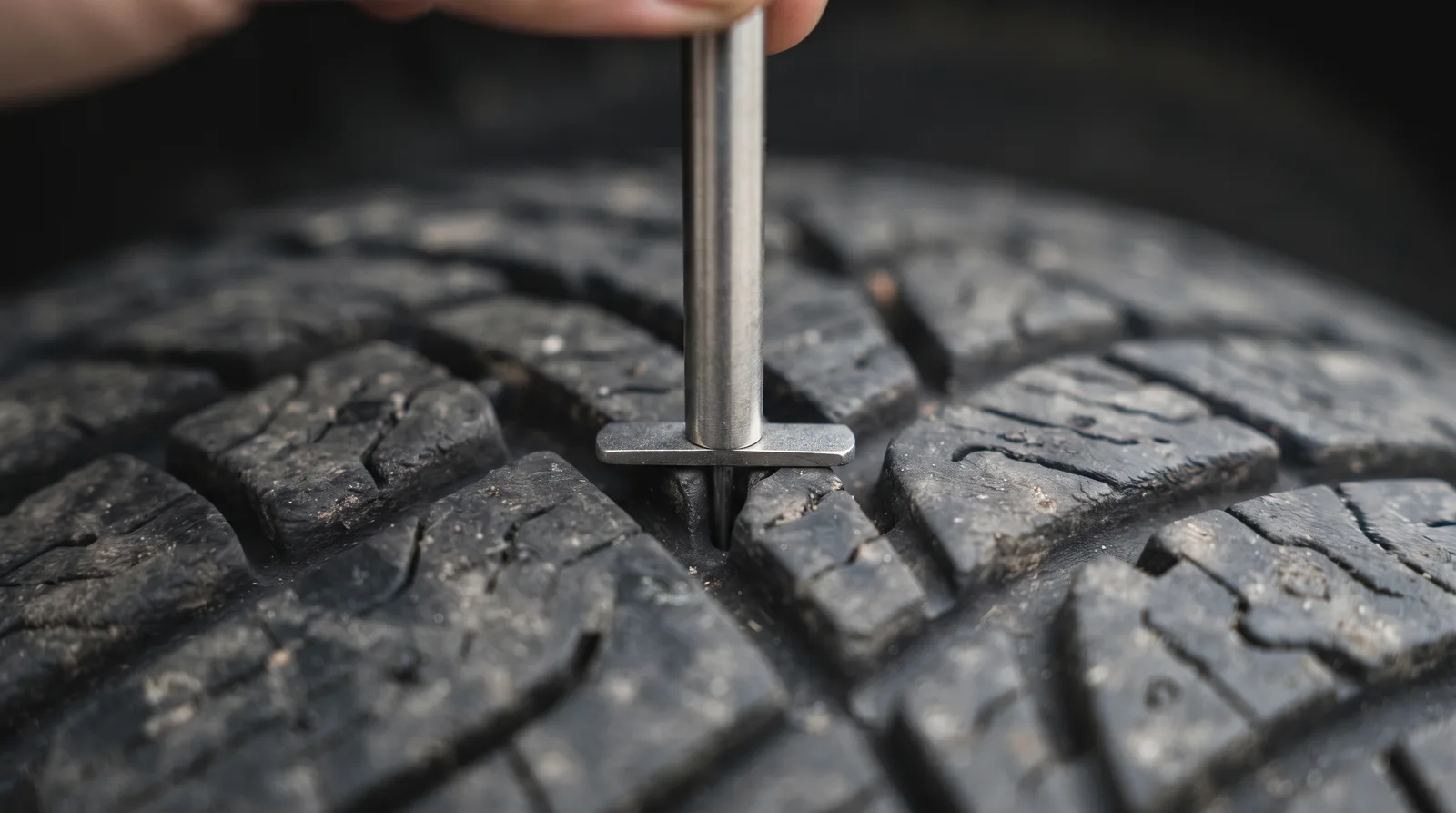
The UAE legal minimum is 1.6 mm of tread. Laufenn's own guidance is to replace when the grooves wear below 2 to 3 mm, because wet grip falls away quickly at the end of a tyre's life. Replacing too early wastes tread you paid for; running too long costs grip on the first wet day. Our guides to when to replace your tyres and driving in UAE rain explain the trade-off.
Choosing a tyre for high mileage
Look for what the maker says the tyre was designed to do. A touring tyre built around tread life and comfort will usually outlast a sporty tyre in the same size, which trades some life for grip. Three examples from the ranges we distribute:
- Laufenn G FIT AS (listed as LH41): Laufenn describes it as offering long tread life, with what it calls a long-mileage carbon compound and a low-noise pattern. We carry it from 14 to 17 inch. See the sizes.
- Landspider Citytraxx G/P: Landspider calls it a value-oriented year-round tyre aimed at long tread life and a comfortable ride, and grades it the longest-wearing of its Citytraxx range. We carry it in 15 and 16 inch. See the sizes.
- Laufenn S FIT2 (listed as LK12): for drivers who want a sportier tyre without giving up on life; Laufenn says it was developed for "exceptional mileage" alongside wet grip. We carry it from 15 to 18 inch. See the sizes.
For a car on 195/65 R15 or 205/55 R16, such as a Toyota Corolla, both the G FIT AS and the Citytraxx G/P are in our range. Whatever you choose, fit a matched set on each axle and keep the tyres rotated, so the whole set reaches the end of its life together.
A five-minute monthly routine
- Check all four pressures cold, against the placard.
- Look across the width of each tread: even wear is good, one worn edge means alignment or pressure.
- Run a hand along each sidewall for cuts, cracks or bulges.
- Note the odometer, so rotation lands every 10,000 km.
- Glance at the tread wear bars; when the tread is close to them, plan the replacement.
Frequently asked questions
How often should a high-mileage driver rotate tyres?
Laufenn's guidance is every six months or every 10,000 km, whichever comes first, so a car that covers big distances may need it every few months. With tyres bought from GCCO, rotation every 10,000 km is free at any branch.
Is a more expensive tyre always cheaper per kilometre?
No. A premium sports tyre can wear faster than a good touring tyre, and price says little about life on its own. Compare tyres designed for the same job, check what the maker says each is built for, and then look after them; habits decide more of the result than the badge.
Does nitrogen make tyres last longer?
Nitrogen helps a tyre hold its pressure more steadily, and correct pressure is what makes tyres last. It does not replace the monthly cold check. With tyres bought from us, nitrogen filling is free.
When should I replace tyres on a high-mileage car?
The legal minimum is 1.6 mm, but Laufenn recommends replacing when the grooves wear below 2 to 3 mm, because wet grip drops quickly near the end. Replace sooner for any sidewall bulge, deep cut or exposed cord.
Should I buy two tyres or four?
If the set has worn evenly, four, so it lasts and wears together. If only two are worn, replace them as a pair on one axle and fit the new pair on the rear; our mixing tyres guide explains why.
If any of this leaves you unsure about your own tyres, bring the car to your nearest branch and we will look with you - we have 8 across the UAE, the head office is on Al Nahda Street, Industrial Area 8, Sharjah, and we are open daily from 9:00 AM to 10:00 PM. You can also order on gcco.ae and choose mobile fitting at checkout, or message our team on WhatsApp at +971 800 525 - a real person will answer. Toll free 800 525.


