
Just Fitted New Tyres? What to Do in the First 500 km: Break-In, Wheel-Nut Re-Check and Pressure

The car comes down off the lift, the old tyres go on the pile, and most people drive away and never think about the new set again until the next time something feels wrong. That is fine; tyres are not delicate. But a new tyre is not quite finished when it leaves the workshop. The rubber on its surface is new, the wheel it is bolted to has just been off the car, and the pressure in it was set in a warm workshop. There is a short list of things worth doing in the first 500 km that cost nothing, and a couple worth doing before you leave the branch at all.
This is that list, with the reasons, so you can judge for yourself which parts matter for your car.
Before you drive away: two things to check at the counter
The date on the tyres. Every tyre carries a four-digit date code inside a small oval on the sidewall - week and year of manufacture. A new tyre should be recent, and since the UAE inspection fails tyres older than five years, an old date on a "new" tyre is costing you part of its legal life. Our guide to the tyre DOT date code shows where to find it and how to read it; it takes ten seconds per tyre. It is entirely reasonable to ask to see them before the tyres go on.
The locking wheel nut key, if your car has one. Many cars have one special wheel nut per wheel that needs its own key. The fitter uses it and should hand it back; if it stays in the workshop you find out at the worst possible moment, on the hard shoulder with a puncture. Check it is back in the car before you leave.
The first few hundred kilometres: why new tyres want a gentle start
A tyre is cured in a heated mould, and a release agent is used so the finished tyre comes out of that mould cleanly. A thin film of it is left on the tread of a new tyre, and the tread surface itself is smooth and glossy until it has been scrubbed by the road. On top of that, a new tyre has its full depth of tread - roughly 8 mm against perhaps 3 mm on the tyres you just took off - so the tread blocks are taller and flex more. Both effects make a brand-new tyre feel slightly different for a while: a little softer in the steering, a little less eager to bite, and a little more prone to let go early if you push it.
Tyre makers address this directly in their fitting advice, and they broadly agree: drive moderately for the first few hundred kilometres - most quote somewhere between 300 and 500 km - avoiding hard braking, fast cornering and sudden acceleration, so the surface film wears off and the tread settles. There is no need to drive slowly; normal highway speed is fine. The point is to avoid asking the tyre for its maximum grip before it is ready to give it. If the first rain of the season arrives in that window, treat the car as having less grip than you expect; our guide to driving in UAE rain covers the rest.
The feeling of "my new tyres are not as sharp as my old ones" usually passes within the same few hundred kilometres. If it does not - if the car genuinely pulls, wanders or vibrates - that is not break-in, and the section below on balancing and alignment applies.
At 50 to 100 km: the wheel-nut re-check
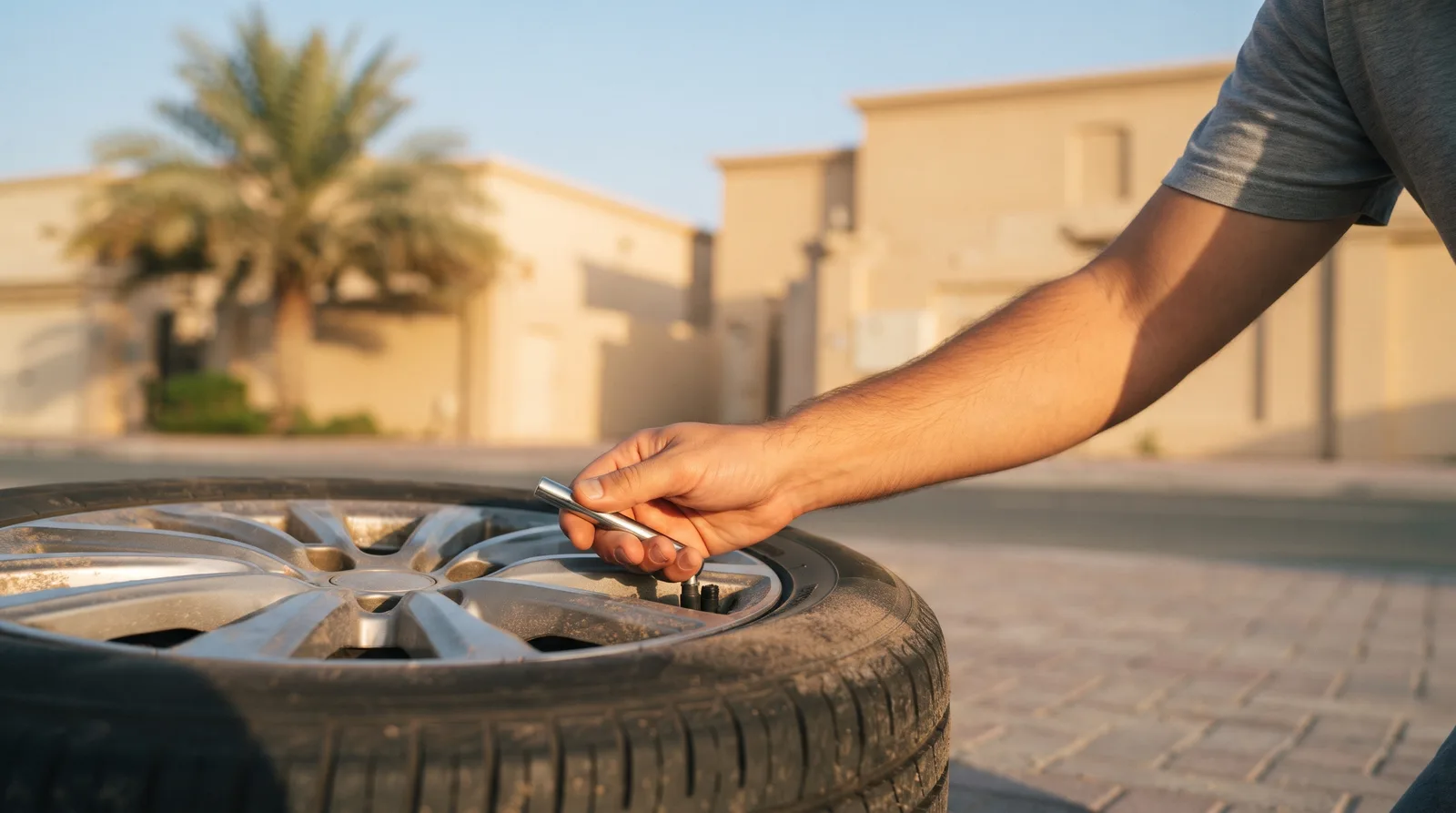
This is the one most people skip, and it is the most important item here. When a wheel is refitted, the nuts are tightened to a set torque - the twisting force the carmaker specifies, printed in the handbook. As the car is then driven, the wheel settles fully against the hub, and the clamping force can ease off slightly, especially on alloy wheels and especially if the hub face and the back of the wheel were not perfectly clean. A nut that has lost some of its clamp is not about to fall off, but a wheel held by nuts at uneven tension can wear and in the worst case loosen further. Wheel makers and fitters alike recommend re-checking the torque after roughly 50 to 100 km of driving.
How it is done matters as much as doing it. A torque wrench set to the handbook figure, working in a star pattern across the nuts, and stopped when the wrench clicks. Not an impact gun: over-tightening stretches the studs and can distort the brake disc behind the wheel, which you then feel as a pulsing brake pedal. If you have a torque wrench, use the figure in your car's handbook; it differs between makes and even between models, so a typical number is no substitute. If you do not, bring the car to the branch that fitted the tyres, or any of our 8 branches, and ask for the wheel nuts to be re-torqued; it takes a couple of minutes.
The next cold morning: pressure
Pressures are set in the workshop, which in the UAE is rarely a cool place. The reference pressure is always a cold one - the car parked for at least three hours, or driven less than about two kilometres. So the morning after fitting, before the first drive, check all four against the placard on the driver's door frame and adjust. Our guide to tyre pressure in the UAE heat explains the placard, why the petrol-station gauge reads high, and why you never let air out of a hot tyre.
Two things to add for a new set. First, if the tyres were filled with nitrogen - free with tyres bought from us - the placard pressure is unchanged; nitrogen simply holds its pressure a little more steadily. Second, check again a week later. A tyre that has lost noticeably more than its neighbours in the first week has a problem that was there from the start: a valve not fully seated, a bead that did not seal cleanly against the rim, or a wheel with a small nick in the sealing lip. All are fixable, and the sooner you come back the simpler it is. Do not just keep topping it up.
The tyre pressure light
If your car has a tyre pressure warning system, it may need to learn the new set. Most cars sold here in recent years have a sensor inside each wheel; on many of them the system carries on as before, and on others the sensors have to be re-taught after a tyre change, which a workshop does with a scan tool. Cars that work the pressure out from the wheel-speed sensors instead have to be reset after new tyres so they learn the new set as the reference; until they are, a false warning is common. The handbook says which system you have and how to reset it, usually a menu item or a button. If the light is still on after a correct cold pressure check and a reset, come back: a sensor may have been damaged during fitting, or its battery may be at the end of its life. Our guide to the tyre pressure warning light covers what the light is actually telling you.
Balancing and alignment: what a new set should and should not do
New tyres should be balanced when they are fitted, and balancing is free with tyres bought from GCCO. A balanced set should be smooth at every speed. If a vibration appears in a narrow speed band - very often between 90 and 120 km/h, felt through the steering wheel or the seat - most often a wheel has lost a weight or was not seated squarely on the hub, and occasionally the tyre itself is out of round; come back and have it checked and re-balanced. Vibration is not something to "give a few hundred kilometres"; it does not improve on its own.
Alignment is different and is not automatically part of fitting tyres. The moment to think about it is now: look at the tyres you just took off. If they wore evenly across the tread, the alignment is probably fine. If one edge was gone and the other deep, or the inside shoulders were feathered, the car has been wearing its tyres unevenly for a reason that new rubber does not fix, and the new set will go the same way. Our guides to what tyre wear patterns mean and to alignment versus balancing will tell you which it is. A car that drifts to one side on a flat, straight road with your hands loose on the wheel wants an alignment check, new tyres or not.
Two housekeeping items
Note the odometer. Rotation - swapping the tyres between positions so they wear evenly - is free every 10,000 km with tyres bought from us, at any branch. Write down the reading at fitting, or set a reminder, so the first rotation lands on time. Our guide to how often to rotate tyres explains why it is worth the stop.
Keep the invoice. A manufacturing defect in a tyre usually shows itself early - a bulge or a wobble that balancing does not cure - and a warranty claim normally needs the invoice. Keep the paperwork with the car documents, and if you replaced only two tyres, remember that the new pair belongs on the rear axle, for the reasons in our guide to mixing tyres.
Frequently asked questions
Do new tyres really need breaking in?
Yes, gently. Most tyre makers advise a few hundred kilometres - commonly 300 to 500 km - of moderate driving while the mould release film wears off the tread and the tread surface roughens. Normal speeds are fine; avoid hard braking and fast cornering. Treat the first wet drive in that window with extra care.
Why do wheel nuts need checking again after fitting?
As the wheel is driven it settles fully against the hub, and the clamp on the nuts can ease slightly, especially on alloy wheels. Re-checking them with a torque wrench to the handbook figure after 50 to 100 km catches this. Do not have them tightened with an impact gun; over-tightening is as harmful as under-tightening.
My new tyres feel softer than my old ones. Is something wrong?
Usually not. New tyres have around 8 mm of tread against the 2 to 3 mm you removed, so the blocks flex more, and the glossy new surface has less bite until it is scrubbed in. That feeling fades within a few hundred kilometres. A vibration or a steady pull to one side is different and should be looked at straight away.
When should I re-check the pressure after new tyres?
On the next cold morning before driving, against the placard on the driver's door frame, and again a week later. Any tyre that has lost clearly more than the others in that first week has a seating or valve fault that the fitter should correct.
Should I align the car when I change tyres?
Only if there is a reason: the old tyres wore unevenly, the car pulls on a flat road, or you have had a hard kerb or pothole strike. If the old set wore evenly and the car tracks straight, you do not need an alignment just because the tyres are new.
If any of this leaves you unsure about your own tyres, bring the car to your nearest branch and we will look with you - we have 8 across the UAE, the head office is on Al Nahda Street, Industrial Area 8, Sharjah, and we are open daily from 9:00 AM to 10:00 PM. You can also order on gcco.ae and choose mobile fitting at checkout, or message our team on WhatsApp at +971 800 525 - a real person will answer. Toll free 800 525.


