
Driving in UAE Rain: Aquaplaning, Tread Depth and the Checks Before the First Storm

Most years, most of the UAE's rain arrives between November and March, and the first storm of the season is the one that catches people out. It lands on roads that have been dry for six or seven months, lifts a film of dust and oil off the surface, and fills the dips and underpasses faster than the drains can empty them. The cars you see on the hard shoulder that afternoon mostly did nothing dramatic. They were driving at their normal speed on tyres that were fine when it was dry.
This is what actually happens to a tyre on a wet road, why the two numbers you already check - tread depth and pressure - decide most of it, and the short list of things worth doing before the first storm rather than after it.
What aquaplaning is, in one paragraph
A tyre grips a wet road by pushing the water out of the way. The grooves in the tread are channels: as the tyre rolls, water is squeezed into them and thrown out to the sides, so the rubber blocks between the grooves touch the asphalt. That works up to a point. Drive fast enough, or through water deep enough, and more water arrives under the tyre each moment than the grooves can clear. A wedge of water builds up at the front of the contact patch, the tyre climbs onto it, and for as long as that lasts the rubber is not touching the road at all. That is aquaplaning. The steering goes light, the engine may rev as the driven wheels spin up, and nothing you do with the wheel or the brakes has any effect until the tyre comes back down.
Four things decide how early it happens: how fast you are going, how deep the water is, how much groove is left to clear it, and the tyre pressure. You control three of them.
Why tread depth matters more in the rain than anywhere else
A new car tyre starts life with roughly 8 mm of tread. The UAE legal minimum is 1.6 mm, and our guide to the tyre rules, inspection and fines covers what happens at the test. On a dry road the difference between 8 mm and 2 mm is small - the rubber is still touching the asphalt. On a wet road the difference is the whole story, because the grooves are the only thing moving the water, and a worn tyre has shallow grooves that fill up at a lower speed.
Tyre makers test this and publish the results, and the pattern is the same across all of them: wet braking distances grow steadily as the tread wears, and grow quickly once it is below about 3 mm. Some manufacturers and motoring organisations recommend replacing at 3 mm for that reason; others hold that the legal 1.6 mm is adequate when pressures are right. Where you draw that line is your call. What is not in doubt is that a tyre at 2 mm will aquaplane at a lower speed than the same tyre at 6 mm, and will take noticeably longer to stop in the wet.
Finding out where yours are takes a minute: every tyre has small raised bars moulded across the bottom of the main grooves at the 1.6 mm mark. When the tread blocks are level with those bars, the tyre is at the limit. A tread depth gauge costs very little and tells you the actual number, which is more useful than a glance. Our guide to the signs you need new tyres shows what to look for.
Why pressure matters too
An under-inflated tyre flattens and spreads under the car's weight. That sounds like more rubber on the road, and on a dry road it is roughly that. On a wet road it is the opposite: the tread grooves close up as the tyre squashes, the contact patch gets longer and flatter so water has further to travel before it escapes, and the tyre rides up onto the water earlier. Under-inflation is the one tyre fault that makes wet grip worse in two ways at once.
Check pressures cold - before driving, or after the car has sat for a few hours - against the placard inside the driver's door. Our tyre pressure guide explains the placard and why the number on the sidewall is not the one to use. If the pressure light has come on, the warning light guide covers what it means and what to do next.
Driving the first wet days
The first hour of the first storm is the slipperiest the road will be all year, because the dust and oil that have been settling since spring are still on the surface, suspended in a thin layer of water. It washes off after a few hours of steady rain. Until then, and in any heavy rain after, the useful habits are these:
- Slow down more than feels necessary. Speed is the one factor in aquaplaning that you can change instantly. Many drivers find that 20 to 30 km/h below their dry-road speed on the highway is about right in heavy rain, and slower still through standing water.
- Double the gap to the car in front. Wet stopping distances are longer on any tyre, and you cannot see standing water until you are nearly on it.
- Avoid the puddles you can see. The sheets of water that collect in the outside lane, in underpasses and at the bottom of flyover ramps are where aquaplaning happens. The inside lanes are usually drier because the road is cambered towards the edge.
- Switch cruise control off. If the driven wheels start to aquaplane, cruise control can respond by adding throttle, which is the opposite of what you want.
- Follow the tracks of the car ahead where you can. Its tyres have already pushed some of the water aside.
If the steering suddenly goes light and the car feels as though it is floating, that is aquaplaning. Do not brake hard and do not turn the wheel sharply: with no grip, neither will do anything, and when the tyres come back down the car will do whatever the wheel is now asking, which may be a swerve. Ease off the throttle smoothly, hold the wheel straight or on a gentle line, and wait. It usually lasts a second or two. When the tyres bite again, brake gently if you need to.
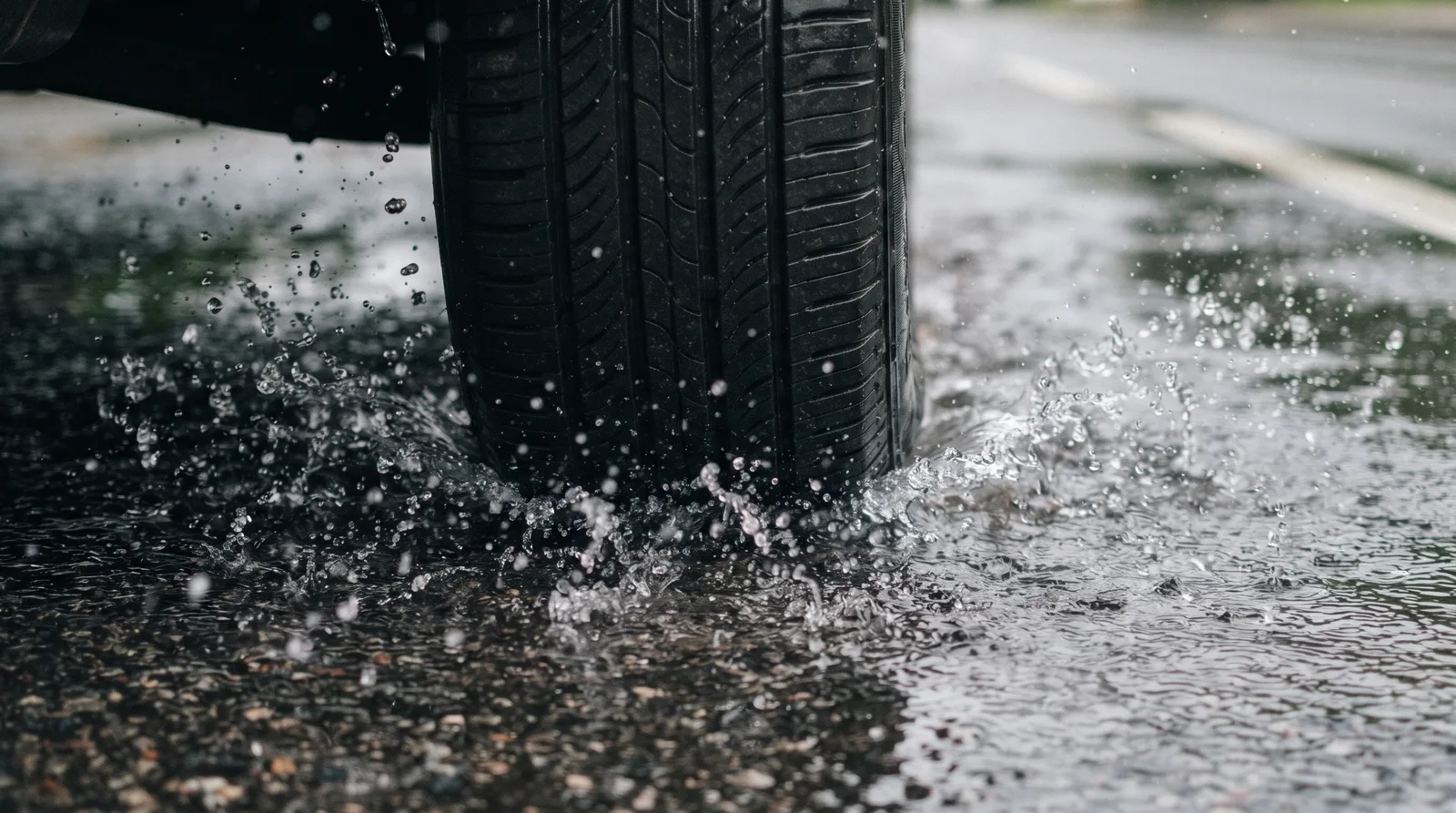
The check to do before the rain, not after
Ten minutes, in the shade, with the car cold:
- Tread depth on all four tyres, inner and outer edges as well as the middle. Uneven wear is common on cars that have not been aligned, and a tyre that is fine in the centre can be at the bars on one shoulder. Our guide to wear patterns shows what each one means.
- Pressures against the door placard, including the spare.
- Sidewalls, for cuts, bulges or cracking. Summer is hard on rubber here, and a tyre that spent the hot months slightly under-inflated has had a worse summer than its tread suggests.
- Age. The DOT date code tells you when the tyre was made. Old rubber is harder rubber, and hard rubber grips less in the wet.
- Wipers. Not a tyre, but the other half of seeing the standing water in time. Blades that have baked all summer usually smear rather than clear.
If two of the four are near the limit, replace them as a pair on the same axle - our replacement guide explains why a mismatched axle is a bad idea in the wet - and have the car aligned if the wear was uneven, or the new tyres will go the same way. Balancing, nitrogen filling, rotation every 10,000 km and a full checkup are free at our branches, so the check itself costs nothing but the drive.
Frequently asked questions
At what speed does aquaplaning start?
There is no single number. It depends on water depth, tread depth, pressure and tyre width as much as speed, and a worn, under-inflated tyre can aquaplane at speeds where a new, correctly inflated one is fine. The practical rule is that in standing water you should be well below the dry speed limit, and the deeper the water, the slower.
Should I lower my tyre pressures in the rain for more grip?
No. Lower pressure closes the tread grooves and lengthens the contact patch, which makes aquaplaning more likely, not less. Run the placard pressure in the rain exactly as you would in the dry.
Do I need special rain tyres in the UAE?
No. Normal summer or all-season tyres with good tread depth and the right pressure handle the UAE's rain. What you do not want is a tyre near the wear bars, or one that is old and hardened. Winter tyres, which are designed for snow and cold roads, are not the answer here and wear quickly in our temperatures.
Is the legal 1.6 mm enough for the rain?
It is the legal minimum, and a tyre at 1.6 mm with correct pressure will pass inspection. It will also stop a good deal later in the wet than a tyre with more tread, which is why several manufacturers suggest replacing at 3 mm. If you can, replace before the rain rather than after it.
If any of this leaves you unsure about your own tyres, bring the car to your nearest branch and we will look with you - we have 8 across the UAE, the head office is on Al Nahda Street, Industrial Area 8, Sharjah, and we are open daily from 9:00 AM to 10:00 PM. You can also order on gcco.ae and choose mobile fitting at checkout, or message our team on WhatsApp at +971 800 525 - a real person will answer. Toll free 800 525.