
Sidewall Bulges, Cuts and Cracks: Which Can Wait and Which Cannot

The tread is the part of a tyre everyone looks at, and the part the inspection measures. The sidewall is the part that actually holds the air in and carries the car, and it fails in ways the tread never does: suddenly, without a warning light, and usually at speed. Most sidewall damage is obvious once you look. The problem is that nobody looks, and the inner sidewall - the side facing the car - is not visible from where you stand at the petrol pump.
This is how to tell a harmless scuff from a tyre that should not be driven, in the order you are most likely to meet them.
A bulge: the tyre has already failed
A bulge is a smooth, rounded swelling that stands out from the sidewall, anywhere from the size of a coin to the size of an egg. It is not a manufacturing lump and it will not go down. Inside the sidewall is a layer of cords, usually polyester, running from bead to bead; they are what give the sidewall its strength. A hard impact - a pothole at speed, a kerb taken at an angle, a speed bump hit too fast - can snap some of those cords without marking the outside. The air inside then pushes the rubber outward through the gap, and the bulge is the rubber alone holding back the pressure.
Rubber alone is not designed to do that. The bulge grows with heat and speed, and the usual end is a blow-out, often on the highway where the tyre is hottest. It cannot be repaired: there is no way to rejoin the cords, and no patch or plug addresses the problem. Replace the tyre. If the bulge is on a front tyre and you have a full-size spare, swap it before you drive anywhere; if it is small and the car must move, drive slowly to the nearest tyre shop and no further. Our guide to spares and repair kits covers the limits of a space-saver on the way.
One more thing about bulges: they are a sign of what happened, not only of what is wrong. If the car hit something hard enough to break cords, the wheel may be bent and the alignment knocked out. Have both checked when the tyre is replaced.
Cuts: it depends on what you can see
Sidewall cuts come from kerbs, debris and the edges of potholes. The question is depth. A shallow cut or scuff that has removed some rubber but shows only black rubber underneath is cosmetic; the cords are well below the surface, and the tyre is fine. A cut that shows any fabric - the pale cords, or a texture like woven cloth - has gone through the protective rubber, and the tyre should be replaced. Cords exposed to air and water weaken, and a cut that reaches them is a weak point that gets worse rather than better.
Sidewall cuts cannot be repaired. The repairable area of a tyre is the centre of the tread, where the belts are and where a plug can be sealed properly; our puncture repair guide explains why the sidewall is excluded. A cut or puncture on the sidewall or the shoulder means a new tyre regardless of how small it looks.
Cracks: age, heat and under-inflation
Fine cracking on the sidewall - a network of small lines, sometimes called crazing or weather checking - is the rubber ageing. Sunlight, ozone and heat break down the compound over time, and the UAE delivers all three in quantity. A tyre that has spent summers parked outside will often show it on the side that faced the sun. Under-inflation accelerates it, because a tyre run soft flexes more and runs hotter.
How much cracking is too much is a judgement, and it is worth being honest about that rather than pretending there is a measurement. Shallow surface crazing on a tyre that is otherwise sound and within age is usually a sign to watch it, not to replace it today. Cracks you can get a fingernail into, cracks that follow the sidewall around in a line, or any cracking on a tyre that is at or past five years from its date code mean replacement. Our guides to the DOT date code and to what the summer does to tyres cover the age question in full - and remember that age is also one of the things the inspection checks.
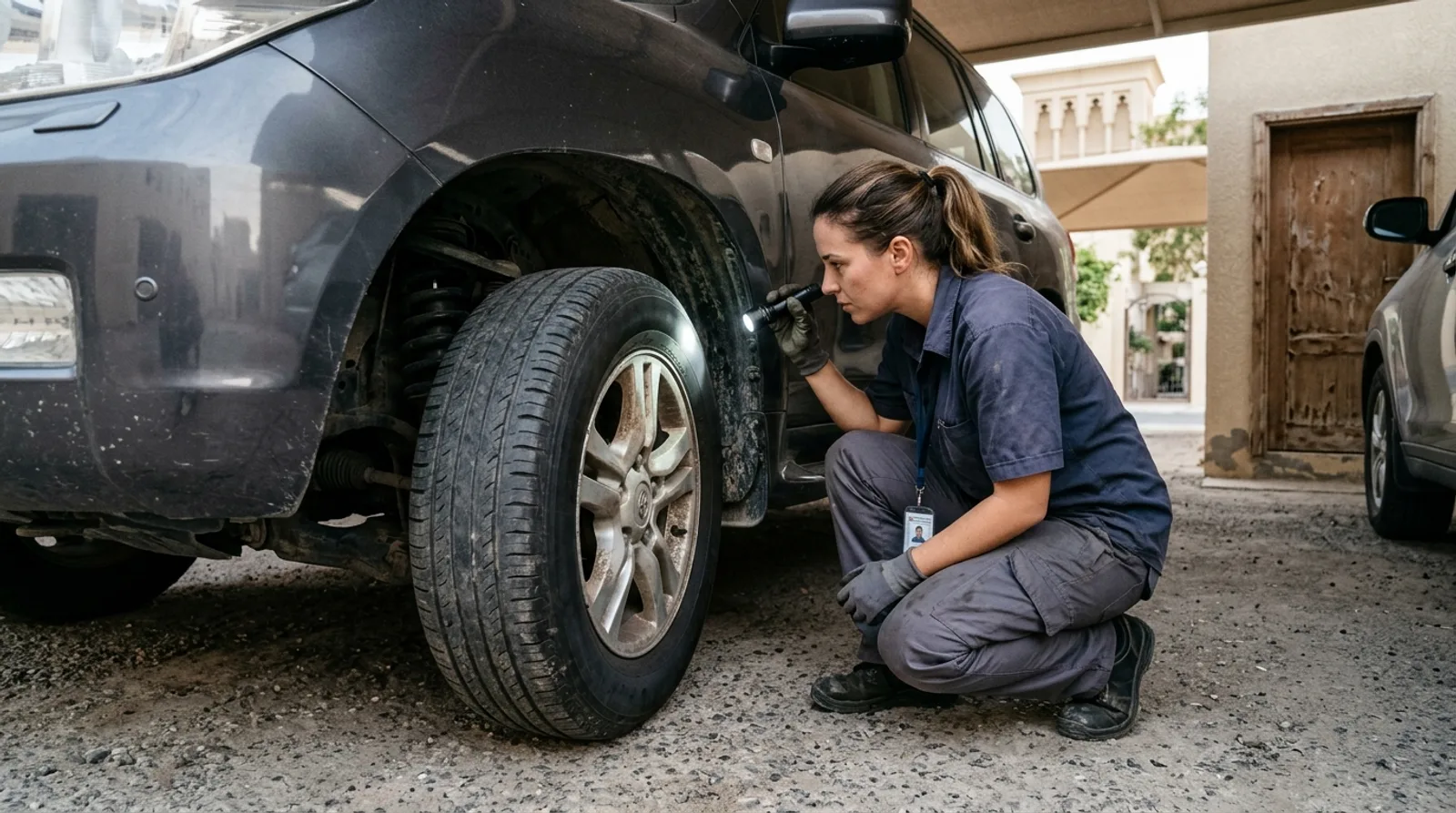
The inner sidewall: the check nobody does
Everything above applies equally to the inner sidewall, and that is where kerb damage from parking and the worst of the heat tends to be. It is also the side you never see. Checking it takes two minutes: on level ground, turn the steering to full lock one way, and the inner sidewall of the opposite front tyre is exposed in the wheel arch; turn to the other lock for the other side. For the rear tyres, crouch and use a torch - the phone's is enough - and look along the inner wall for bulges, cuts and cracking. Run a hand around it if you cannot see clearly; a bulge is unmistakable under the fingers.
Do this after any hard impact, and whenever you check pressures. It is also part of the free full checkup at any of our branches, where the car is on a lift and the inner sidewalls are at eye level.
Scuffs, stains and things that look worse than they are
Not every mark is damage. Kerb scuffs that have polished or lightly scraped the surface without exposing cord are cosmetic. Brown or grey discolouration on the sidewall is usually the protective waxes in the rubber migrating to the surface, which is normal and is sometimes removed by cleaning. Small moulding seams and lettering edges are part of the tyre. Tyre dressing products with a petroleum base can dry the rubber over time; a water-based one is kinder if you use them.
Frequently asked questions
Can I drive on a tyre with a sidewall bulge?
Only as far as the nearest tyre shop, slowly, and only if you have no spare. A bulge is broken cords with rubber alone holding the pressure, and the usual outcome at speed is a blow-out. Swap to the spare if you have one and replace the tyre.
Can a sidewall cut be repaired?
No. Repairs are limited to the central tread area, where a plug can be sealed against the belts. The sidewall flexes with every rotation and no repair holds there. A cut that shows the cords, or any puncture in the sidewall or shoulder, means a new tyre.
How much sidewall cracking is acceptable?
Shallow surface crazing on a tyre within its age is a sign to watch it. Cracks deep enough to take a fingernail, cracks running in a line around the tyre, or cracking on a tyre at or past five years from its date code mean replacement. If in doubt, have it looked at on a lift.
Does sidewall damage come under the tyre's warranty?
Usually not. Manufacturers' warranties generally cover defects in materials and workmanship, and impact damage from potholes and kerbs is excluded as road hazard damage. Some makers sell separate road-hazard cover; check what came with the tyre.
If any of this leaves you unsure about your own tyres, bring the car to your nearest branch and we will look with you - we have 8 across the UAE, the head office is on Al Nahda Street, Industrial Area 8, Sharjah, and we are open daily from 9:00 AM to 10:00 PM. You can also order on gcco.ae and choose mobile fitting at checkout, or message our team on WhatsApp at +971 800 525 - a real person will answer. Toll free 800 525.