
Road-Trip Tyre Checklist: Before Hatta, the Mountains or the Long Highway

Once the heat breaks, the UAE drives. Hatta for the weekend, the mountain roads out east, the long highway to the other emirates with the boot full and five people in the car. Those trips put more through the tyres in a day than a month of commuting does: more weight, more hours at highway speed, more braking on descents, and a long way from the nearest tyre shop if something goes wrong. A short check in the week before is the difference between a trip and a story.
This is the list, in the order that catches the most problems for the least effort. Everything on it is about tyres; what you need for the border, the insurance or the car's other systems is a different article.
1. Pressures, cold, for the car you will actually be driving
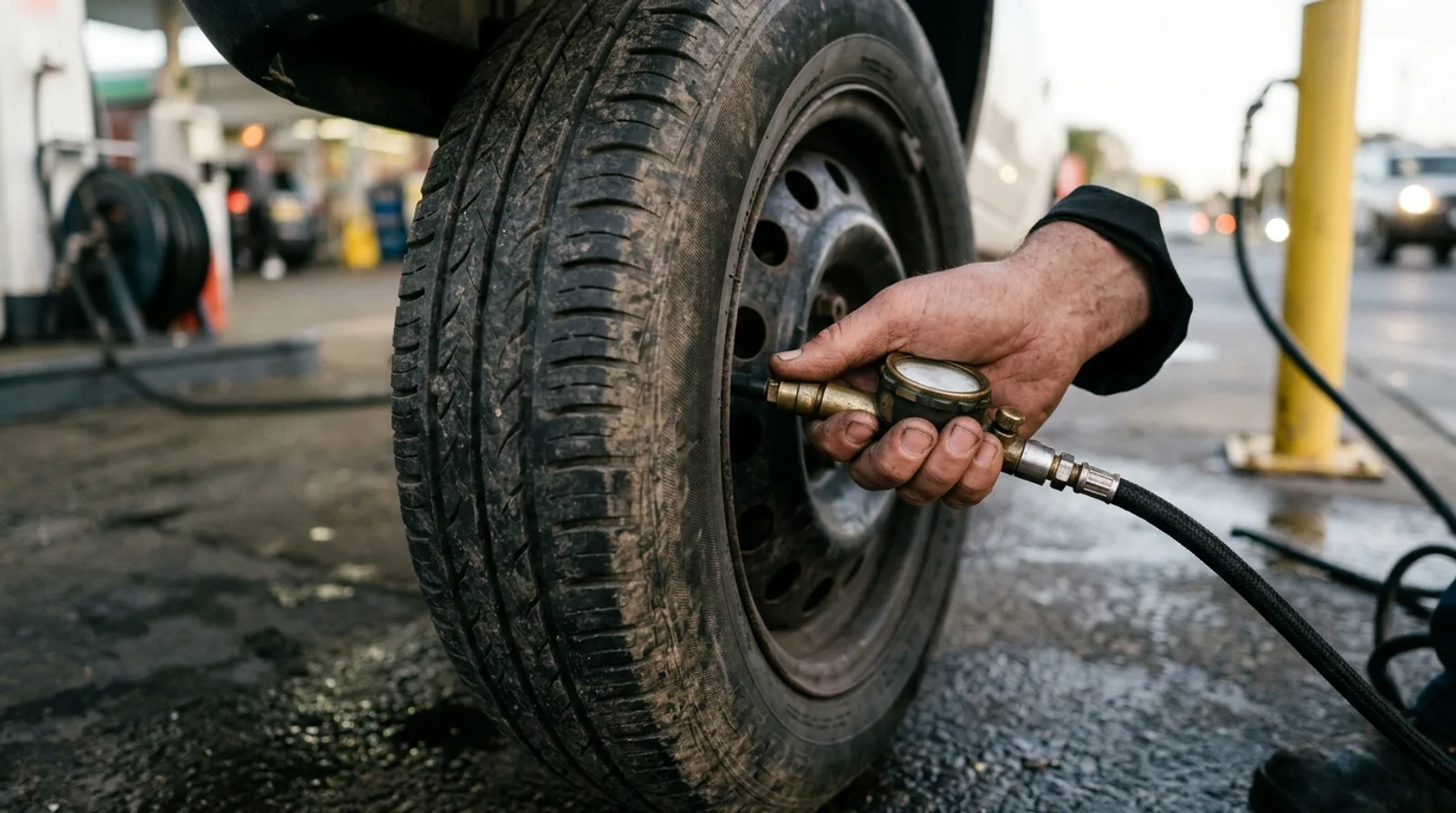
The placard inside the driver's door usually gives two sets of pressures: one for normal driving and a higher one for a fully loaded car. A trip with the boot full and every seat taken is the loaded case, and the higher figure is the one to use. Set it the morning you leave, before driving, when the tyres are cold - our pressure guide explains why a reading from a tyre that has just driven to the petrol station is meaningless.
Two things to know for the drive itself. First, pressures rise as the tyres warm on a long highway run, typically by several psi, and that is normal: do not let air out of a hot tyre to bring it back to the cold figure, or you will be under-inflated once it cools. Second, if you plan to lower pressures for sand, that is a separate exercise with its own rules, and our desert driving guide covers deflating and, more importantly, reinflating before you get back on tarmac.
2. Tread depth and age
Check all four tyres, inner and outer shoulders as well as the centre. A tyre near the wear bars is a bad companion on a long highway and a worse one if it rains in the mountains. If any tyre is close to the limit, replace it before the trip rather than planning to do it after: the signs to look for are in our replacement guide, and a mismatched pair is covered in our guide to mixing tyres.
Check the date codes too. A tyre that is at or past five years from manufacture, whatever its tread, is a candidate for replacement in our climate, and the DOT code guide shows where to read it. Long hours at highway speed in warm air are exactly the conditions in which old rubber lets go.
3. Sidewalls, both sides
Walk around the car and look at every outer sidewall for cuts, bulges and cracking; then turn the steering to full lock and look at the inner sidewalls of the front tyres, and use a torch for the rears. Our guide to sidewall bulges, cuts and cracks explains which ones mean the tyre does not go on the trip. A bulge found at home costs a tyre; a bulge found at 120 km/h on the E11 costs rather more.
4. The spare and the things that go with it
The spare is the tyre that only matters on the road trip, and the one most likely to be flat, old or missing. Check its pressure - a space-saver often needs around 60 psi, printed on it - and its condition. Then check the things around it:
- The jack and the wheel brace are where they should be and the brace fits the nuts.
- The locking wheel nut key, if the car has locking nuts. Without it, nobody can change the wheel, including the roadside service.
- The sealant kit, if that is what the car has instead of a spare: the bottle is in date and the compressor works. Read the instructions now, in daylight, not on the hard shoulder.
Our guide to spares, space-savers and repair kits covers what each one can and cannot do and how far a space-saver may take you.
5. Load and speed
Every tyre carries a load index and a speed rating, and a loaded road trip is where they are tested. Add up what you are carrying - people, luggage, a roof box, a trailer's nose weight if you are towing - and keep it within the car's limits in the handbook, which are set with the fitted tyres' load index in mind. Sustained highway speed on a fully loaded car is the hardest thing you can ask of a tyre, and a correctly inflated tyre within its load limit handles it; an under-inflated one carrying too much is how blow-outs happen in summer. Our guide to speed ratings and load index explains both numbers.
A roof box also raises the car's centre of gravity and catches crosswinds, which the tyres feel as more lateral load in corners and gusts. Nothing to do about that except drive accordingly, and keep the pressures at the loaded figure.
6. Rotation and alignment, if they are due
If the car is due a rotation, do it before the trip rather than after, so the tyres with the most tread go where the car needs them. Rotation is free at our branches every 10,000 km, and our rotation guide explains the patterns. If the car pulls to one side, or the steering wheel sits off-centre on a straight road, have the alignment checked too; a long drive on a misaligned car can scrub a visible amount of tread off one shoulder in a day.
On the road
Stop every couple of hours anyway. While you are stopped, a glance at the tyres and a hand on the sidewall is enough to catch a tyre running hotter than the others, which is the early sign of low pressure. If the pressure warning light comes on at speed, our warning light guide covers what to do. On long descents in the mountains, use a lower gear and let the engine hold the car rather than riding the brakes; it is the brakes that overheat, but the tyres sit next to them and share the heat.
And when you are back: re-check pressures once the car is cold, look at the sidewalls again - mountain roads and gravel lay-bys leave marks - and reset to the normal placard figure if you were running the loaded one. Balancing, nitrogen filling, rotation every 10,000 km and a full checkup are free at our branches, which makes the post-trip check an easy one.
Frequently asked questions
Should I use the higher placard pressure for a road trip?
If the car is loaded - a full boot and most seats taken - yes. The placard's higher figure is for exactly that. Set it cold on the morning you leave, and reset to the normal figure when you unload.
My tyre pressures went up during the drive. Should I let air out?
No. Tyres warm up on a long run and the pressure rises by several psi; that is normal and expected. Letting air out of a hot tyre leaves it under-inflated once it cools. Only adjust pressures when the tyres are cold.
How much can I carry before the tyres are overloaded?
The handbook's load limit for the car is the figure to respect, and it is set with the fitted tyres' load index in mind. Count everyone and everything, including a roof box. If you have changed to tyres with a lower load index than the placard, that limit no longer applies, which is one reason never to do it.
Do I need to check the spare if I never use it?
Especially then. A spare loses pressure slowly over years, and a space-saver needs a much higher pressure than the road tyres. It also ages at the same rate as the others. Check it before every long trip.
If any of this leaves you unsure about your own tyres, bring the car to your nearest branch and we will look with you - we have 8 across the UAE, the head office is on Al Nahda Street, Industrial Area 8, Sharjah, and we are open daily from 9:00 AM to 10:00 PM. You can also order on gcco.ae and choose mobile fitting at checkout, or message our team on WhatsApp at +971 800 525 - a real person will answer. Toll free 800 525.