
What Your Tyre Wear Is Telling You: Edges, Centre, Feathering and Cupping

There is a habit every experienced tyre fitter has, and customers often do not notice it: before saying a word about a new tyre, they run a palm across the old one. Inner edge, middle, outer edge, then back the other way. It takes three seconds, and it tells them more about the car than the customer usually can - the pressures it has been run at, whether the alignment is out, whether a shock absorber has given up, and whether the tyres have ever been rotated.
You can read the same things yourself. Tyres wear in patterns, and each pattern points at a cause. Fix the cause, and the next set lasts as long as it should. Skip it, and a brand-new set goes the same way as the old one, usually faster, because new tread has more to lose.
How to look, in five minutes
Park on level ground with the steering turned to full lock, so the front tyres show you their whole tread. Crouch, look across the tread from the inner edge to the outer edge, and compare the depth of the grooves at each. Then run your palm across the tread, both directions. Then look around the circumference for anything that repeats - dips, flat areas, a scalloped edge. Do the rears from behind. A tread depth gauge makes it precise, but you do not need one to spot any of the patterns below, and the wear bars moulded into the grooves - which our UAE tyre rules guide explains - tell you when any part of the tread has reached the 1.6 mm legal limit.
Both edges worn, centre still deep
Cause: under-inflation. A tyre with too little air sags in the middle and rides on its shoulders, so the shoulders wear and the centre does not. It is the single most common pattern in the UAE, because pressure is lost quietly through the summer and nobody checks - and a tyre run soft in this heat also runs hot, which is how sidewalls fail on the highway.
Fix: set the pressures cold, to the figure on the driver's door placard, and check them monthly. Our guide to tyre pressure in UAE heat has the details, including why the petrol-station reading at midday misleads you.
Centre worn, edges still deep
Cause: over-inflation. Too much air makes the tyre crown, so the middle of the tread carries most of the load. People do it deliberately to save fuel, or after reading the maximum pressure on the sidewall and mistaking it for the recommendation.
Fix: the same as above - the door placard number, cold. The maximum on the sidewall is a limit for the tyre, not a setting for the car.
One shoulder worn, inner or outer
Cause: alignment, almost always. If the wheel leans in or out (camber), or points slightly in or out (toe), one edge of the tyre is dragged along the road while the rest rolls, and that edge disappears. Inner-edge wear on the front tyres is the classic UAE finding after a year of kerbs, potholes and speed bumps taken too quickly. Inner-edge wear on the rear is common on some modern cars by design and gets much worse if the tyres are never rotated. Hard cornering, a lowered car, or a bent suspension arm can all do it too.
Fix: an alignment check before anything else, and rotation to share the wear. Fitting new tyres to a car with the alignment out is the most expensive mistake on this list - the new set is ruined in months. Alignment versus balancing explains what the technician's printout means.
A sawtooth you can feel before you can see it
Cause: toe misalignment. Run your palm across the tread. If the tread blocks feel sharp in one direction and smooth in the other, like a saw, the tyre is being scrubbed sideways as it rolls - the wheels are pointing slightly towards or away from each other. This is called feathering, and it is often felt long before it is visible. On the rears it usually means the rear toe is out.
Fix: alignment. Toe is the angle that goes out most easily and the one that eats tyres fastest, and it is also the easiest to correct.
Scallops or dips around the tyre
Cause: the tyre is bouncing. Regular scooped-out patches around the circumference - cupping, or scalloping - mean the tyre is not being held against the road evenly as it rolls. Worn shock absorbers are the usual reason, because their job is to stop the wheel bouncing; a badly out-of-balance wheel or a worn suspension joint can do the same. This is the pattern that hums or roars at speed, and it gets louder as it develops.
Fix: check the shock absorbers and suspension first, then balance. A cupped tyre cannot be smoothed out again; if it is noisy, it is replaced, and the cause is fixed so the new one does not follow it. Balancing is free with tyres bought from GCCO.
Tread blocks worn at an angle: heel and toe
Cause: mostly normal, made worse by not rotating. Look at a single tread block: if one end of it is lower than the other, all the way around the tyre, that is heel-and-toe wear. It comes from the blocks flexing as they meet the road and leave it, and block-pattern tyres on driven or braked axles show it more. A little is normal and harmless. A lot means the tyres have gone too long without rotation, and it brings a droning noise with it.
Fix: rotate on schedule - our rotation guide covers the patterns - and check the pressures. If the noise is already there, it will fade slowly with rotation but not disappear.
A single flat spot
Cause: a locked wheel, or a long time parked. One flat, smooth patch on an otherwise healthy tyre usually means the wheel stopped turning while the car was still moving - an emergency stop on an older car without anti-lock brakes, or a fault in the anti-lock system on a newer one. A milder version comes from a car left standing for weeks with the same patch of tyre pressed against the ground; that one often works itself out after some driving, once the tyre warms up.
Fix: if it thumps at speed and does not fade, the tyre is replaced. If it followed an emergency stop on a modern car, have the brakes checked - a wheel should not lock.
Diagonal wear on the rear tyres
Cause: rear toe, or a front-wheel-drive car that is never rotated. Patches of wear running diagonally across the tread of a rear tyre, often with a rhythmic noise, are a common finding on front-wheel-drive saloons and hatchbacks. The rears carry little load, roll along with a slight toe angle, and are never moved, so the same patches scrub for years.
Fix: a rear alignment check and a proper rotation schedule.
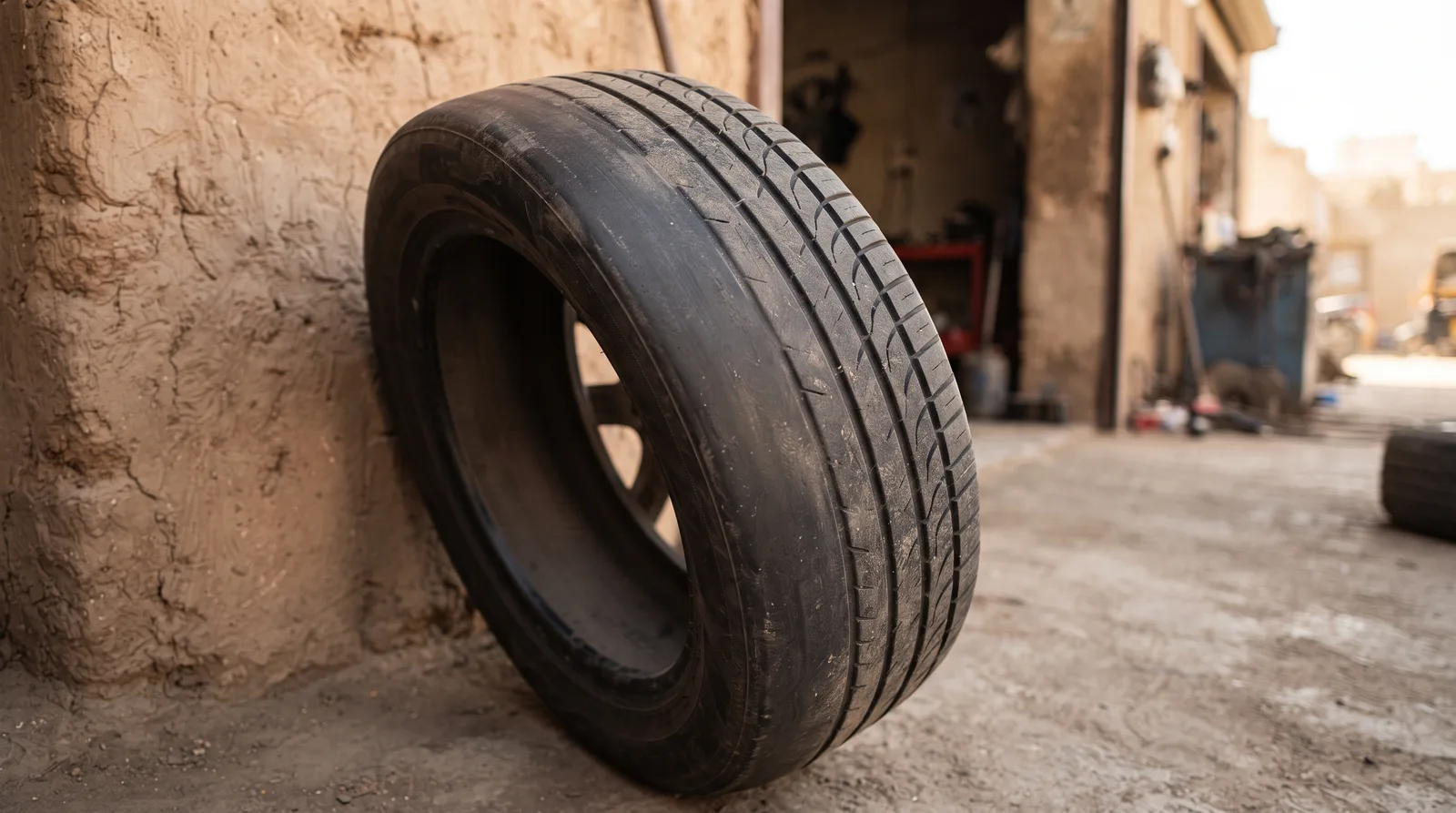
The fronts are simply more worn than the rears
Cause: normal. Front tyres steer, brake and on most cars drive, so they wear faster. Two worn fronts and two good rears is not a fault - it is what happens without rotation, and it is why we rotate free every 10,000 km on tyres bought from us.
One tyre is wearing far faster than its partner
Cause: something is wrong at that corner. Two tyres on the same axle should wear alike. If one is going much faster, look for a reason on that side: alignment knocked out by a kerb, a brake that is dragging - the wheel will be hotter than the others after a drive - or a bent or worn suspension component. A dragging brake in particular deserves attention quickly; it heats the tyre as well as wearing it.
What to do once you have read the tyre
- Fix the cause first. Pressures, alignment, shock absorbers, brakes - whichever the pattern pointed at. New tyres on the same fault last no longer than the old ones did.
- Decide whether the tyre itself is finished. Uneven wear cannot be reversed. If the tread is above the wear bars across its whole width and the tyre is not noisy or vibrating, it can be kept and rotated. If any part of the tread has reached the bars, it fails the registration test and it is unsafe in the first rain - the signs you need new tyres covers the rest.
- Start rotating. Every 10,000 km. It will not cure a fault, but it will make sure no single tyre carries all of it.
Frequently asked questions
Is wear on the inner edge of the tyre normal?
A little, on the rear of some modern cars, is designed in. Heavy inner-edge wear, or inner-edge wear on the fronts, means the alignment is out - usually camber or toe knocked out by a kerb or a pothole. Have it checked before you fit new tyres.
Can uneven tyre wear be fixed?
The cause can; the missing rubber cannot. Fix the pressures, alignment or suspension, then keep the tyre if it is above the wear bars across its whole width and not noisy. Otherwise replace it, and fix the cause so the new tyre does not wear the same way.
Why are my front tyres wearing so much faster than the rears?
Because the fronts steer, take most of the braking and, on most cars, put the power down. It is normal, and rotating the tyres every 10,000 km is what evens it out.
What causes the humming noise from my tyres?
Uneven wear, most often cupping from worn shock absorbers or heel-and-toe wear from long gaps between rotations. Run your hand around the tread: if it feels lumpy or sawtoothed, the noise is the tyre. Fix the cause; the tyre may need replacing if the noise is bad.
Should I replace one worn tyre or both on the axle?
Both, unless the other one is nearly new. Tyres on the same axle should match in tread depth so that grip and braking are even side to side. That is also why the minimum order on our site is two tyres.
Not sure what your car needs? Start on our tyre range and filter to your size, or find your nearest branch. We are on Al Nahda Street, Industrial Area 8, Sharjah, open daily from 9:00 AM to 10:00 PM, and our stock runs from Bridgestone and Michelin through to Laufenn. If you would rather send us your size and let us recommend, message our team on WhatsApp at +971 800 525 - a real person will answer. Toll free 800 525.