
Buying a Used Car in the UAE? Read the Tyres First: What They Reveal About the Car

Most people start a used-car viewing at the paint and finish it at the price. The tyres get a kick, if that. Yet the four tyres and the wheels they sit on are the one part of a car that a seller cannot easily tidy up for a viewing, and they keep an honest record of how the car has been driven, parked and looked after.
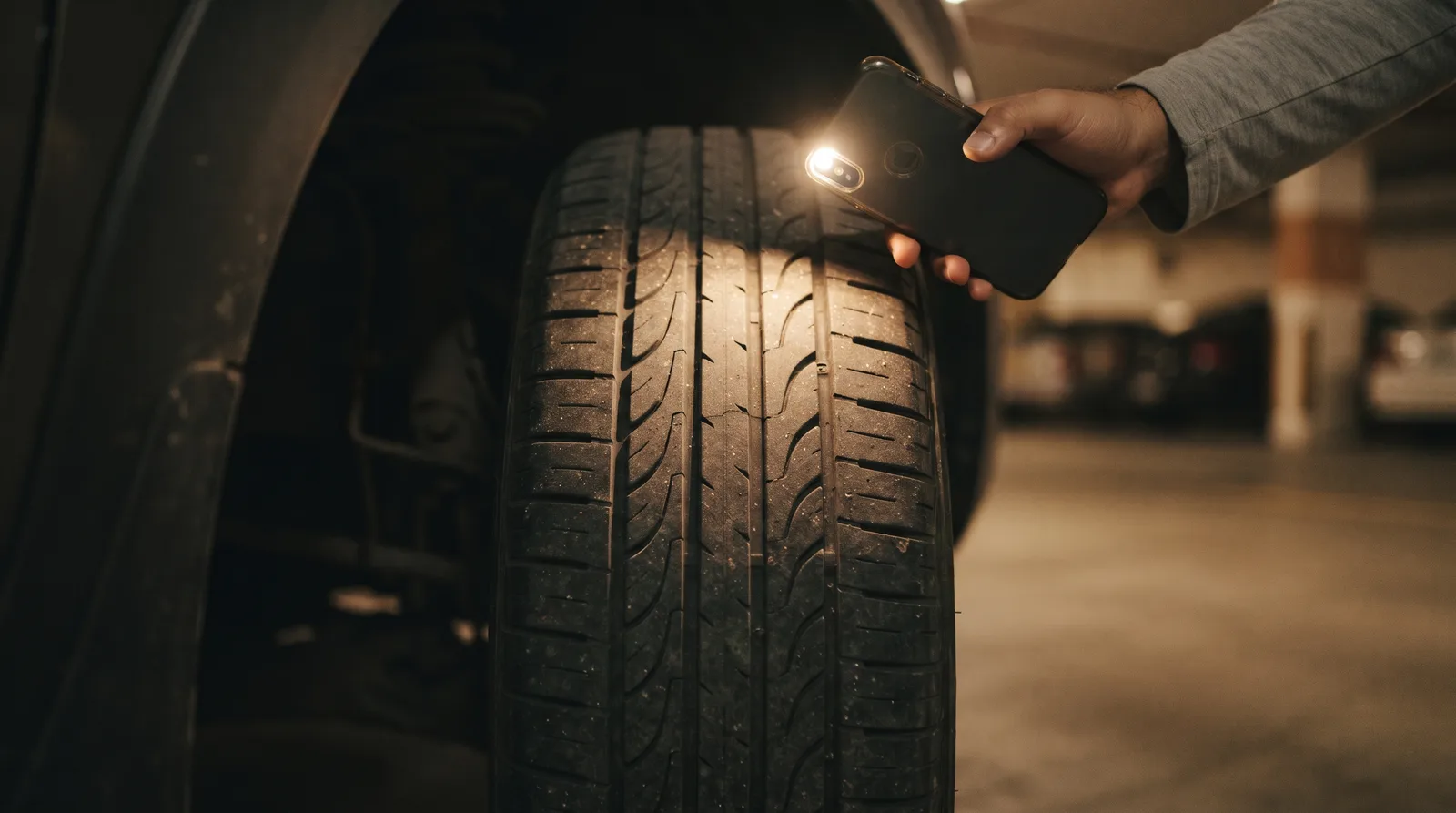
You do not need tools or experience, only ten minutes, the torch on your phone and a willingness to crouch. Here is what to look at, in order, and what each thing is telling you.
Why the tyres deserve ten minutes
There are two reasons. The first is money: a full set of tyres is one of the larger bills a new owner can meet in the first month, and you would rather know before you agree a price than after. The second is the transfer itself. For most used cars the change of ownership needs a technical inspection, and that inspection fails tyres worn below 1.6 mm or more than five years old, as our guides to ownership transfer and the UAE tyre rules explain. A car on old tyres cannot simply be driven to the test and registered.
1. Read the date on all four tyres, and the spare
Every tyre carries a four-digit code on the sidewall giving the week and year it was made; our guide to the DOT date code shows where to find it. Read all four and write them down.
- All four close together, and a few months older than the car: these are probably the tyres it left the factory on. On a car more than four years old, that means a new set is due soon, whatever the tread looks like.
- All four the same, and newer than the car: the set has been replaced once, together. That is what a careful owner does.
- Four different dates: the tyres have been replaced one at a time, as each one failed. Ask why. Repeated punctures are bad luck; repeated damage on one corner can point to a bent wheel or a hard life.
- Anything more than five years old: budget for replacing it before the transfer test.
Do the spare as well. A spare that has never touched the road ages just the same, and it is the tyre most often forgotten; our guide to your spare tyre covers what else to check in the boot.
2. Are all four the same tyre?
Look at the brand and the pattern name on each sidewall. The ideal is four of the same. A matching pair on the front and a different matching pair on the rear is common and fine. What deserves a question is two different tyres on the same axle, because the left and right of an axle should always match; our guide to mixing tyres explains why.
On an all-wheel-drive car or a 4x4, look harder. Those cars need all four tyres to match and to be worn by a similar amount, because a mismatch works the drivetrain; our guide to replacing tyres on all-wheel drive explains what the carmakers ask for. One brand-new tyre beside three half-worn ones on an all-wheel-drive SUV is a reason to ask how long it has been driven that way.
It is also worth noticing what was chosen. A premium saloon on four tyres from its original maker, perhaps with the carmaker's own approval mark, says something about how the owner looked after the rest of the car; our guide to OE tyre markings shows what those marks look like. The cheapest available tyres on an expensive car are not a fault, but they are a clue about how the last few years of servicing were approached.
3. Read the wear across each tread
Turn the steering to full lock so that you can see the whole width of a front tyre, then do the other side. Look at the inner edge, the middle and the outer edge, and run your hand across the tread.
- Even wear across the width, similar on both sides of the car: the car is probably tracking straight and the pressures have been looked after.
- One edge worn much more than the rest, usually the inner one: the alignment is out. That is a small job to correct, but ask what knocked it out. A hard kerb or pothole strike, or an accident repair, can leave the same signature.
- One front tyre worn very differently from the other: something differs from side to side, and it deserves a workshop inspection before you buy.
- Both edges worn, centre good: the tyres have been run under-inflated for a long time.
- Scalloped dips around the tread that you can feel with your palm: often tired shock absorbers.
Our guide to tyre wear patterns has the full list. Remember that new tyres hide all of this. If a car is offered on four brand-new tyres, the evidence has gone with the old ones, so ask what came off and why, and pay more attention to how the car drives: on a straight, flat road the steering wheel should sit level and the car should not pull to one side.
While you are there, check the depth. The wear bars in the main grooves mark 1.6 mm, the legal minimum. A tyre close to them needs replacing now, and its grip on a wet road fell away well before it got there.
4. Sidewalls and wheels
Run your eyes and a hand around each sidewall, including the inner face that you can only see with the torch.
- A bulge means cords inside the tyre are broken and it must be replaced; see our guide to sidewall bulges, cuts and cracks.
- Fine cracks in the sidewall or between the tread blocks are age and sun, and they suggest the car has lived outside.
- A plug or patch in the sidewall or shoulder is a repair that should not have been made; our puncture repair guide shows where the repairable area ends.
- Scraped wheel rims are parking damage and mostly cosmetic. A flattened or pushed-in section of rim is not; our guide to alloy wheel damage explains the difference. Heavy damage on one corner only, together with odd wear on that tyre, is worth a closer look at the suspension behind it.
5. Compare the size with the door placard
Open the driver's door and find the tyre placard on the frame. It lists the tyre size the car was built for, with its load index and speed symbol, and the pressures. Compare it with what is written on the tyres; our guide to reading a tyre size explains the string.
A different size is not automatically a problem, since many cars have more than one approved size, but it is a question for the seller: were the wheels changed, and are the originals still available? Larger aftermarket wheels change the ride and the cost of every future set of tyres; our guide to fitting bigger wheels covers what has to stay the same. A load index or speed symbol lower than the placard's is a firmer problem, because the inspection can fail a car for it; our guide to speed and load ratings shows how to compare.
6. The spare, the tools and the dashboard
- Lift the boot floor. Is there a spare, a jack and a wheel brace, or a sealant kit and compressor? If the wheels have locking nuts, is the key there? Without it, the first puncture becomes a workshop job.
- If the car is on run-flat tyres, it may have no spare by design; our guide to run-flat tyres explains what that means when they need replacing.
- Switch the ignition on. The tyre pressure warning light should come on briefly and go out. A light that stays on or flashes means low pressure or a sensor fault; our guide to the tyre pressure warning light tells you which.
Turning what you found into a price
Add up what the tyres will cost you in the first months. Any tyre that is past five years, down to the wear bars, bulged or badly repaired needs replacing before or straight after the transfer, and tyres are replaced in pairs on an axle. Look up the car's exact size on gcco.ae to see what a pair or a full set costs in the brands you would actually choose; listed prices include VAT, and each listing shows the tyre's year of manufacture. That figure is a fair thing to bring to the negotiation.
Uneven wear is worth more than the tyres it has spoiled. An alignment is a small job; worn suspension parts or old accident damage are not. If the wear patterns worried you, make the sale conditional on an inspection by a workshop you trust.
Five questions for the seller
- When were the tyres last replaced, and were all four done together?
- Why is that one a different brand, or a different age?
- Has the car had a wheel alignment, and what prompted it?
- Are these the original wheels? If not, where are the originals?
- Where are the spare, the jack and the locking-nut key?
The answers matter less than how easily they come. An owner who knows when the tyres were changed usually knows when the oil was changed too.
Frequently asked questions
Will a used car pass the ownership-transfer test on old tyres?
Not if they are past the limits. The inspection fails tyres worn below 1.6 mm or more than five years from their date of manufacture, whatever the tread looks like. Read the date codes before you agree a price, so that the cost of a new set is part of the deal.
The car has four brand-new tyres. Is that a good sign?
It can be, since it saves you the cost of a set. It also removes the evidence the old tyres carried, so ask what was replaced and why, check that the new tyres match the size and ratings on the door placard, and notice whether the car drives straight.
Do mismatched tyres mean the car has been in an accident?
Not on their own. Tyres are often replaced one or two at a time after punctures. Different tyres on the same axle, a single tyre much newer than the others, and uneven wear on one corner are reasons to ask questions and to have the car inspected, not proof of anything.
How much tread should a used car's tyres have?
The legal minimum is 1.6 mm, shown by the wear bars in the main grooves. A new car tyre typically starts with around 7 to 8 mm, so a tyre close to the bars is at the end of its life and you should price a replacement into your offer.
Should I replace the tyres straight after buying?
Replace anything that is more than five years old, damaged or near the wear bars. If the tyres are sound, set the pressures to the door placard, have the alignment checked if the wear was uneven, and note the date codes so that you know when they will age out.
If any of this leaves you unsure about your own tyres, bring the car to your nearest branch and we will look with you - we have 8 across the UAE, the head office is on Al Nahda Street, Industrial Area 8, Sharjah, and we are open daily from 9:00 AM to 10:00 PM. You can also order on gcco.ae and choose mobile fitting at checkout, or message our team on WhatsApp at +971 800 525 - a real person will answer. Toll free 800 525.


