
All-Wheel Drive or 4x4: Do You Really Have to Replace All Four Tyres?

A nail goes through the shoulder of one tyre and it cannot be repaired. The other three have plenty of tread left. On most cars the answer is simple: replace that tyre and its partner on the same axle. Then someone at the counter looks at your SUV and says that because it is all-wheel drive, you need all four.
Sometimes that is right, and sometimes it is an expensive over-simplification. What carmakers really ask for is that the four tyres match. Whether a new tyre can match three used ones depends on how worn they are, and you can work that out yourself in a few minutes.
Why all-wheel drive cares about tyre size
On a two-wheel-drive car the front and rear axles have nothing to do with each other. On an all-wheel-drive car or a 4x4 they are connected through the drivetrain, and that connection assumes that all four wheels cover the same distance with every turn.
Jeep explains the full-time version: a centre differential allows the front and rear wheels to rotate at different speeds during cornering. It is there for the brief differences of a bend. Put tyres of different size on the two axles and the difference never stops. Nissan's handbook for one of its all-wheel-drive models spells out the consequence: a difference in circumference between the tyres on the front and rear axles "will cause excessive tire wear and may damage the transmission, transfer case and differential gears". Jeep's own wording is that four-wheel-drive vehicles depend on tyres of equal size, type and circumference on each wheel.
A worn tyre is a smaller tyre
This is the part most people miss. Two tyres with the same size on the sidewall are only the same size when they have the same tread depth. Every millimetre of tread that wears away takes about 6 mm off the tyre's circumference.
Take a typical SUV size, 265/65 R17. With 8 mm of tread it is about 2,440 mm around. Worn down to 3 mm, it is about 31 mm shorter, a little over one per cent. That sounds like nothing, but it means the worn tyre has to turn about five more times in every kilometre to keep up with the new one, and on an all-wheel-drive car the drivetrain is what absorbs the difference.
What carmakers actually say
- Nissan: if excessive tyre wear is found, it recommends replacing all four with tyres of the same size, brand, construction and tread pattern.
- Land Rover: "Ideally, tyres should be replaced in sets of four. If this is not possible, replace the tyres in pairs (front and rear)."
- Kia, in its all-wheel-drive precautions: all four tyres must be the same size, type, tread, brand and load-carrying capacity.
- Jeep: equal size, type and circumference on each wheel.
Notice what is and is not there. Every one of them asks for matching tyres. None of these says that you must always buy four. And few carmakers publish a number for how much difference is too much.
Tyre makers fill part of the gap. Michelin's guidance for four-wheel-drive vehicles is that the outside circumference of all four tyres should be within one inch of each other. By the arithmetic above, one inch of circumference is about 4 mm of tread depth. Your car's handbook may be stricter, and where it gives a figure, that figure wins.
One tyre is ruined: how to decide
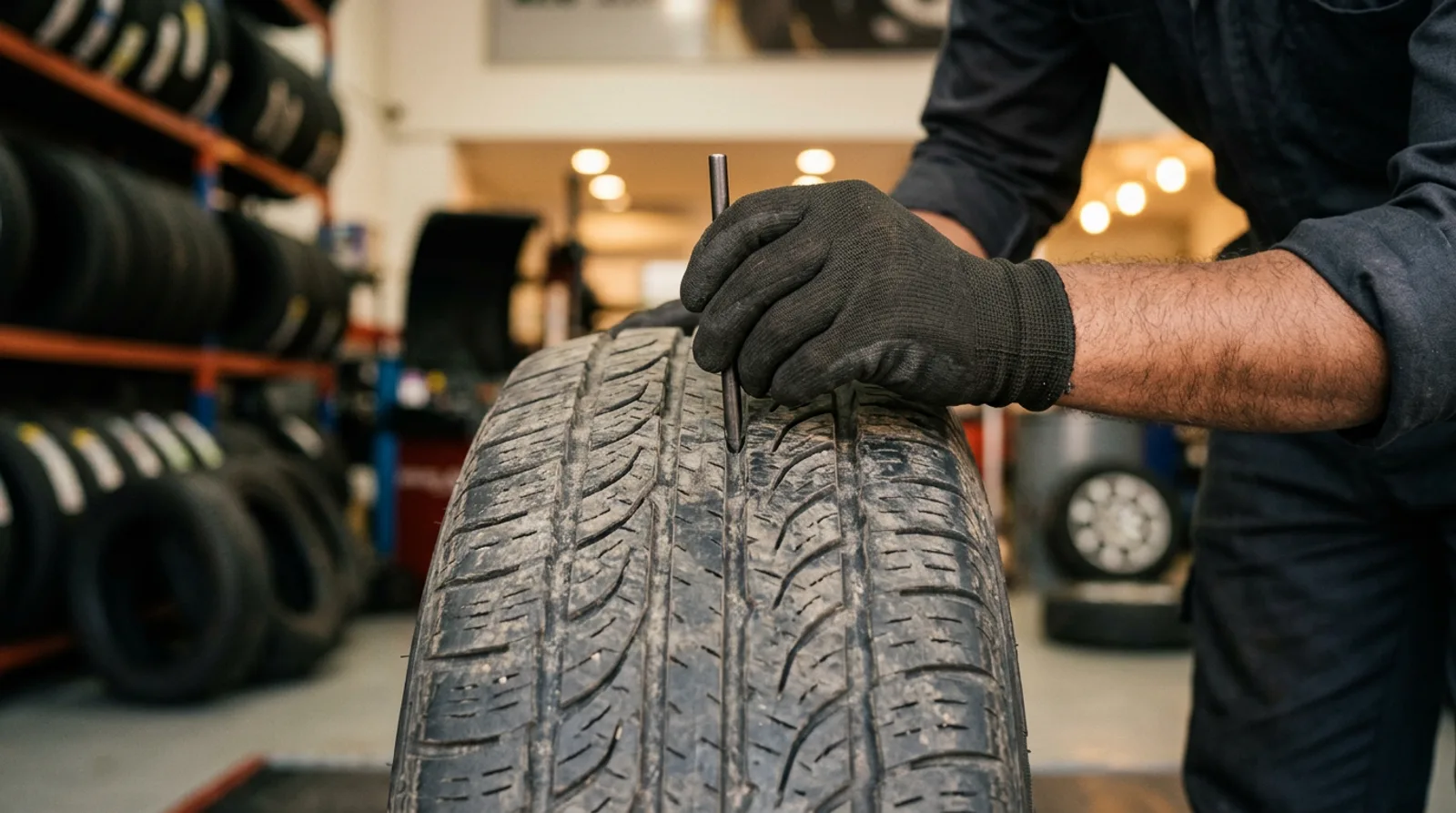
- Measure the tread on the three survivors. A depth gauge costs very little, and any tyre shop will measure for you. A new car tyre typically starts with around 7 to 8 mm.
- If they are nearly new, within a millimetre or two of a new tyre, replace the damaged one with exactly the same tyre: brand, pattern, size, load index and speed symbol.
- If they are part-worn but within about 4 mm of new, check the handbook. Where it allows replacement in pairs, fit two new tyres of the same model on one axle; our guide to mixing tyres explains which axle.
- If they are well worn, replace all four. Tyres more than 4 mm down are in the second half of their life anyway, so most of what you are buying early is tread you would have needed soon.
- Keep to one model. Two different patterns in the same nominal size can differ slightly in real size, and Michelin warns that even slight differences can put extra stress on drivetrain components.
If the same model is no longer made, that is usually the moment for four. Tyre lines are renewed every few years, which is one more reason to note the exact name of what is on your car.
Part-time 4x4 is a different animal
Many pickups and traditional 4x4s have a part-time system: two-wheel drive for the road, and four-wheel drive selected by the driver. Jeep's explanation is that a part-time system has no centre differential, so the front and rear wheels are forced to rotate at the same speed. Its guide describes that mode as giving extra traction for loose, slippery road surfaces only, and its advice for dry pavement is to switch back to two-wheel drive, because the binding that builds up on a grippy surface can lead to overheating and early part failure.
For UAE drivers the habit that follows is simple: four-wheel drive for the sand, two-wheel drive as soon as you are back on the tarmac, and air back in the tyres before you pick up speed, as our guide to desert driving explains. Matching tyres still matter on a part-time 4x4, because the moment you select four-wheel drive, any mismatch is forced through the transfer case.
The spare counts too
A spare wheel is a fifth tyre that may not match the other four. Nissan's handbook says to use only the spare specified for the all-wheel-drive model, and Land Rover limits its temporary spare to 80 km/h and asks for it to be replaced by a standard wheel and tyre as soon as possible. A full-size spare that has never been used has full tread, so beside three worn tyres it is a mismatch as well, and it may be past its age limit; our guide to your spare tyre covers both points.
How to avoid facing the question at all
- Rotate the tyres regularly, so that all four wear at the same rate. Our guide to tyre rotation gives the patterns, and with tyres bought from us rotation every 10,000 km is free.
- Keep the pressures correct and the same on both sides of each axle.
- Have the alignment checked if one tyre is wearing faster than the others; our guide to tyre wear patterns shows what to look for.
- Buy four of the same, and keep a note of the exact pattern name.
If you are choosing a new set for an SUV, our guide to choosing a 4x4 tyre explains the types, and you can browse off-road tyres by size.
Frequently asked questions
Do I have to replace all four tyres on an all-wheel-drive car?
Not always. Carmakers require the four tyres to match in size, type and pattern and to be close in wear. If the other three are nearly new, one matching tyre can be enough; if they are well worn, replacing all four is the safe answer. Your handbook has the final word.
How much tread difference is acceptable on all-wheel drive?
Few carmakers publish a figure. Michelin's guidance for four-wheel-drive vehicles is to keep the circumference of all four tyres within one inch, which works out at about 4 mm of tread depth. If your handbook gives a stricter limit, follow it.
Can I replace just two tyres on a 4x4?
Only if your handbook allows replacement in pairs and the new pair is the same model as the other two and close to them in tread depth. Land Rover, for example, says ideally four, otherwise in pairs.
My crossover is front-wheel drive most of the time. Does this still apply?
Yes. The Nissan and Kia statements quoted above are for exactly that kind of on-demand all-wheel-drive crossover. The system still connects the two axles whenever it sends drive to the rear.
Is it all right to drive in four-wheel drive on the road?
With a full-time or automatic system, yes, that is what it is designed for. With a part-time system selected by the driver, not on dry tarmac: Jeep's advice is to use two-wheel drive on dry pavement and keep four-wheel drive for loose or slippery surfaces.
If any of this leaves you unsure about your own tyres, bring the car to your nearest branch and we will look with you - we have 8 across the UAE, the head office is on Al Nahda Street, Industrial Area 8, Sharjah, and we are open daily from 9:00 AM to 10:00 PM. You can also order on gcco.ae and choose mobile fitting at checkout, or message our team on WhatsApp at +971 800 525 - a real person will answer. Toll free 800 525.


