
Driving in UAE Fog: The 80 km/h Rule, Which Lights to Use, and Why Hazard Lights Are the Wrong Answer

It usually happens on the way to work. The road was clear at home, and then somewhere on the open stretch between two cities the world turns white and the car in front becomes two faint red dots, or nothing at all. Fog in the UAE can arrive quickly, on fast, open roads where people are used to driving at the limit, and it has been behind serious multi-car collisions.
None of the advice that prevents them is complicated, and most of it comes straight from the police. Some of it carries fines. Here is what Abu Dhabi and Dubai police tell drivers to do, what to avoid, and how to decide whether to set off at all.
When to expect it
Fog here is a cool-season event. A study quoted by The National found that it falls mostly between September and March, peaking in December and January, and that it can form any time from about 7pm to 11am, with the peak around sunrise: the hours of the school run and the early commute. The National Centre of Meteorology's climate summary for December notes that the month has brought as many as 20 fog days, in 2014.
The centre issues fog alerts, and the police repeat them on their own channels. Checking before an early drive takes less time than warming up the car.
Rule one: slow down, to 80 km/h in Abu Dhabi
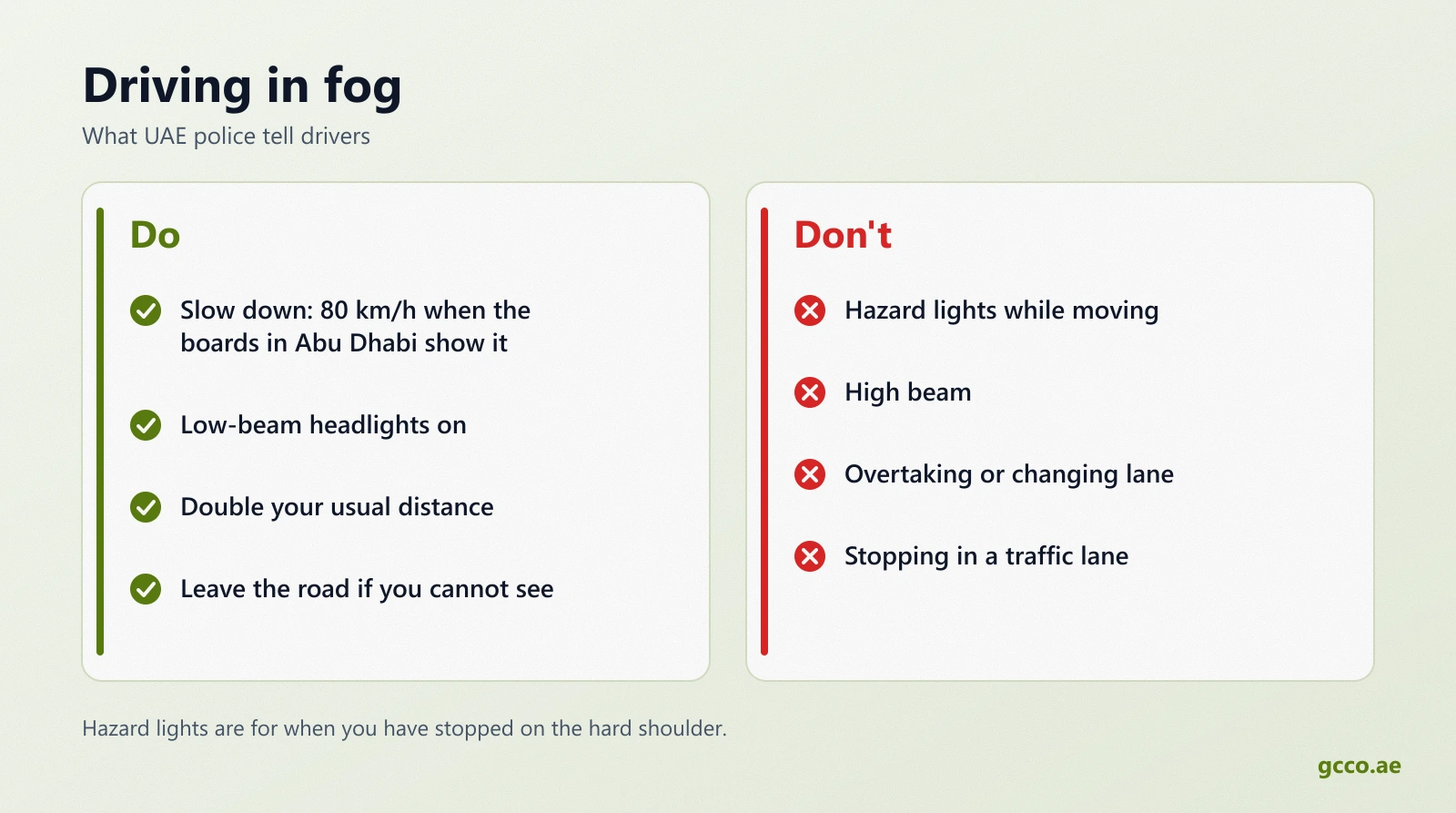
Abu Dhabi has a formal system. When the weather turns, including in fog, rain, high wind and sandstorms, electronic boards over the emirate's main roads show a reduced limit of 80 km/h, under a decision of its traffic safety committee, and drivers must follow it. Abu Dhabi Police also ask drivers to bring their speed down to 80 km/h themselves as soon as they see fog coming down, without waiting for a sign.
Outside Abu Dhabi the principle is the same even where there is no sign: the speed limit is a maximum for a clear day. In fog the right speed is the one at which you can stop within the distance you can see.
Rule two: no hazard lights while you are moving
This is the mistake almost everybody makes, and it feels helpful, which is why it persists. Abu Dhabi Police's instruction is not to use the four-way warning lights except when stopped on the right shoulder of the road, and driving in fog against the authority's instructions carries a Dh500 fine and four black points. Dubai Police give the same advice: Brigadier Juma Salem bin Suwaidan, director of its traffic department, warned motorists in February 2026 not to switch on hazard warning lights while the vehicle is in motion.
The reason is simple. With the hazard lights flashing, your indicators can no longer show that you are changing lane, and the driver behind cannot tell a moving car from one that has stopped.
Rule three: the right lights
- Low-beam headlights on. Both forces say so. Driving in fog without lights is itself a violation, with a Dh500 fine and four black points in the published schedule.
- Not high beam. Dubai Police point out that the reflection of high beams in fog reduces visibility further.
- Fog lamps, if your car has them, are made for exactly this. Switch them off again when the air clears.
Rule four: distance, lane and patience
- Double the gap. Abu Dhabi Police ask drivers to double the safety distance they would leave in normal conditions. Not leaving a safe distance is a fineable offence in any weather: Dh400 and four black points.
- Stay in your lane. Both forces say not to overtake or change lanes unless you have to.
- No sudden braking. Slow down early and smoothly, so that the driver behind has time to see your brake lights.
If you can no longer see
Abu Dhabi Police's guidance is to stop and not drive when visibility is zero. Where you stop matters as much. Dubai Police warn drivers never to stop in the middle of the road, even after a minor accident. The safest place is off the road altogether: a petrol station, a rest area or the next exit. If the hard shoulder is the only option, pull as far to the right as you can, and this is the moment for the hazard lights.
Trucks and buses
In Abu Dhabi, trucks, heavy vehicles and buses, including workers' buses, are banned from moving during fog, with a Dh500 fine and four black points for drivers who ignore the ban. If you drive a car, expect heavy vehicles to be parked up along the route, and leave them room when they move off again.
Before you set off
- Ask whether the trip can wait an hour. Fog here usually lifts as the morning warms up, and no meeting is worth a motorway pile-up.
- Clean the glass, inside and out, and use the demister. A film on the inside of the windscreen turns oncoming lights into glare.
- Check that every light works, front and rear, including the brake lights.
- Look at your tyres. Fog can leave the road surface damp, and stopping distances on a damp road depend on tread depth and pressure. Our guide to driving in UAE rain explains why grip falls away as tread wears, and our guide to tyre pressure explains how to check on a cool morning.
The fines above are the ones in the schedule published at the time of writing. A new executive regulation for the traffic law applies from 1 January 2027, as our round-up of what changes for UAE drivers in 2027 explains, so check the current figures with the police if you need them. The driving advice does not change.
Frequently asked questions
Can I use hazard lights while driving in fog in the UAE?
No. Abu Dhabi Police instruct drivers to use the four-way warning lights only when stopped on the right shoulder, with a Dh500 fine and four black points for driving in fog against the authority's instructions, and Dubai Police also warn against using hazard lights while moving.
What is the speed limit in fog in Abu Dhabi?
When the reduced-speed system is activated, the electronic boards show 80 km/h and that becomes the limit to follow. Abu Dhabi Police also ask drivers to slow to 80 km/h on their own when they see fog.
Should I use high beam or low beam in fog?
Low beam. High beams reflect off the fog and make it harder to see, as Dubai Police point out. Use fog lamps if your car has them.
What should I do if the fog becomes too thick to see?
Leave the road if you can, at a petrol station, rest area or exit. Never stop in a traffic lane. If you have to use the hard shoulder, pull fully to the right and switch on the hazard lights once you have stopped.
Do tyres make a difference in fog?
They do when you need to stop. Fog can leave the road damp, and worn or under-inflated tyres need more distance to stop on a damp surface. Good tyres do not let you drive faster in fog; they give you a better chance when the car in front appears suddenly.
If any of this leaves you unsure about your own tyres, bring the car to your nearest branch and we will look with you - we have 8 across the UAE, the head office is on Al Nahda Street, Industrial Area 8, Sharjah, and we are open daily from 9:00 AM to 10:00 PM. You can also order on gcco.ae and choose mobile fitting at checkout, or message our team on WhatsApp at +971 800 525 - a real person will answer. Toll free 800 525.


