
Camping Season: Tyres for a Fully Loaded Car, a Roof Box or a Boat Trailer

The weather turns, and suddenly every second car on a Thursday evening is heading somewhere with a full boot. Camping chairs and cool boxes for the desert, a roof box for the family trip to the mountains, a jet ski or a small boat behind the SUV on the way to the beach. It is the best time of year to be out, and it is also when tyres are asked to carry far more than they do on the school run.
Weight changes almost everything about how a tyre behaves: how much it flexes, how hot it runs, and how the car brakes and corners. None of it is complicated, but most of it is easy to skip in the rush to leave. This is what to check, in the order you will need it.
Your door placard probably has a second set of numbers
Open the driver's door and look at the tyre placard on the frame. On many cars it lists two sets of pressures: one for normal driving and a higher one for a full load, sometimes with a higher figure for the rear axle only. Some cars give a single set and put the full-load figure in the handbook. Either way, the full-load pressure is there for exactly this weekend.
Carmakers mean it. Nissan's handbooks, for example, tell owners to inflate to the full-load pressure on the placard when towing. Set the pressures the morning you leave, with the tyres cold - before the drive to the petrol station - and remember to bring them back down to the normal figure when you are home and unloaded. Our guide to tyre pressure in UAE heat explains why the cold reading is the one that counts.
How much is too much
Every car has a maximum permitted weight, given in the handbook, and every tyre has a load index that says how much it can carry at its proper pressure; our guide to speed and load ratings explains the number. A seven-seater full of people with the boot packed to the roof can come closer to those limits than you would think.
A few habits keep the load where the car can handle it:
- Heavy things low and forward, against the back of the rear seats, not stacked high at the tailgate.
- Everything secured, so a hard stop does not move it.
- Weight shared fairly between left and right. One side carrying the generator, the water and the cool box loads those two tyres much more than the other two.
- The spare still reachable. A puncture in the desert with the spare buried under the camping kit is a long afternoon. Check its pressure too; our guide to your spare tyre covers the rest.
Roof boxes and roof tents
Your handbook gives a maximum roof load, and it is often lower than people expect. That figure includes the roof bars and the box or tent itself, not just what you put in it. Roof-tent makers also distinguish between the weight the roof can take while driving and the higher weight it can take when parked with people sleeping in the tent, so read both numbers.
Weight on the roof raises the car's centre of gravity, which shifts more of the load onto the outer tyres in every bend and makes the car more sensitive to crosswinds on open desert roads. Take corners and roundabouts more gently than usual, and leave more room to stop.
Towing: what changes for the car's tyres
The handbook gives the maximum weight the car may tow, braked and unbraked, and the maximum downward load on the tow ball. That downward load sits on the rear tyres, which is why many handbooks ask for the full-load pressure, or a specific increase on the rear axle, whenever you tow. Some also set a lower maximum speed while towing. The figures differ from car to car, so take them from your own handbook rather than from a friend's.
Trailer tyres die of age, not wear
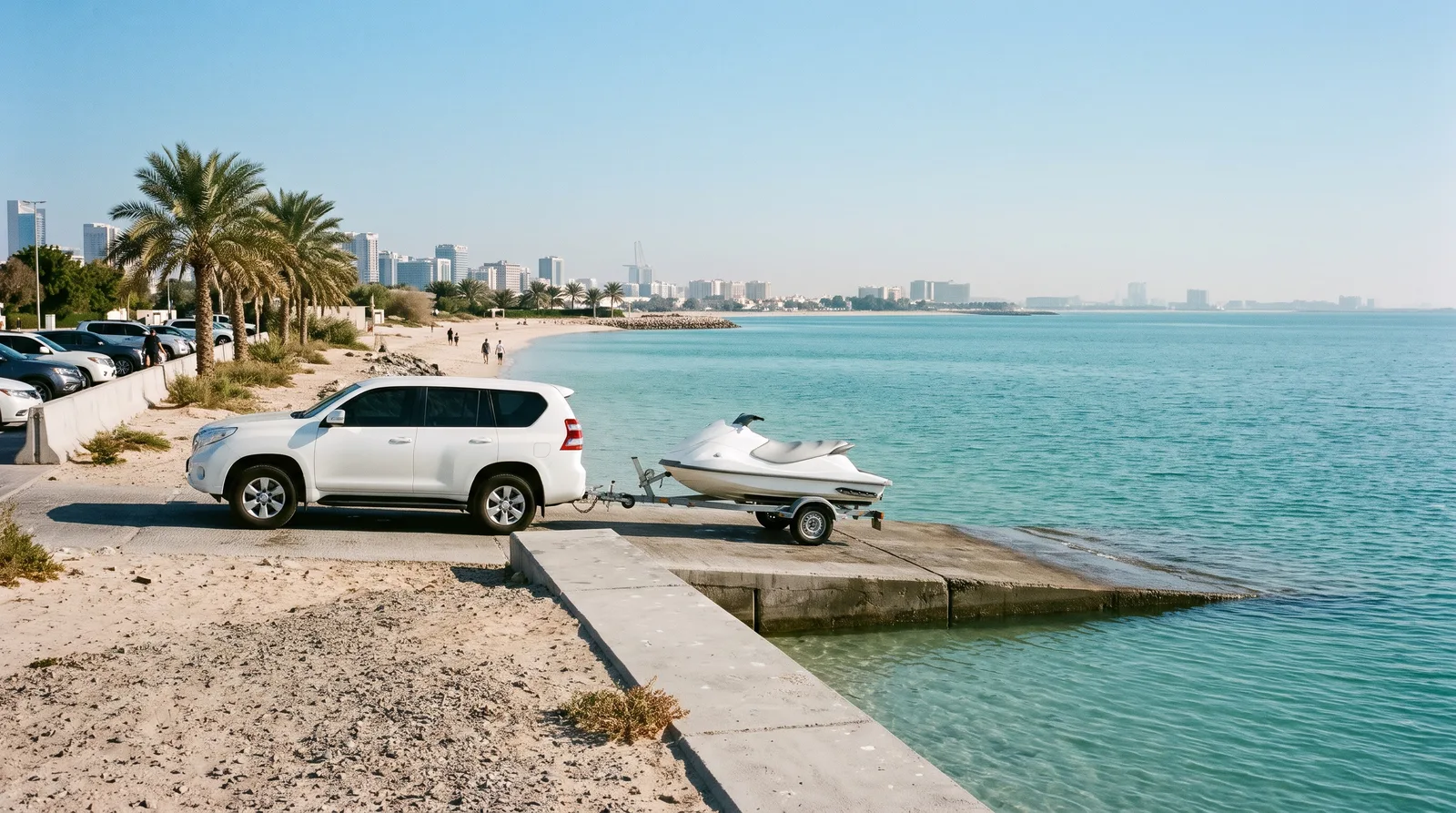
A boat or jet-ski trailer might cover a few hundred kilometres a year, so its tyres almost never wear out. Instead they sit for months in the sun, and the rubber ages. Small trailer tyres also turn faster than car tyres at the same speed, so they work hard when they finally do move.
- Check the age. Find the four-digit date code on each trailer tyre; our guide to the DOT date code shows how to read it. Trailer tyres that look fine can be well past the five years that the UAE inspection applies to car tyres, as our guide to the UAE tyre rules explains, and that is a sensible line for trailers too.
- Look for cracks in the sidewall and between the tread blocks. Our guide to sidewall cracks and bulges explains which can wait and which cannot.
- Use the trailer maker's pressure. It is on the trailer's plate or in its manual. The number moulded on the tyre's sidewall is the most the tyre can hold, not a setting.
- Respect the speed symbol. Some trailer tyres are rated for lower speeds than the car pulling them; the symbol after the size tells you the limit.
- Carry a spare for the trailer and the tools to fit it. The car's spare usually will not fit.
- Look after the wheel bearings after launching in the sea. Salt water is hard on them; rinse the trailer with fresh water after each launch and have the bearings checked regularly. A seized bearing can ruin a tyre and a trip.
If the trip ends on sand
Letting tyres down for sand is normal practice, and our guide to desert driving covers how. Two cautions apply when the car is heavy. A tyre's load capacity depends on its pressure, so a deflated tyre on a fully loaded car is working much closer to its limit: let the tyres down moderately, keep the speed low on the sand, and avoid sharp turns that can push a soft tyre off its rim. And put the air back before you are on the tarmac again, to the full-load figure if the car is still loaded.
The checklist before you leave
- All four tyres set cold to the full-load pressure, plus the spare.
- Trailer tyres at the trailer maker's pressure, dated and free of cracks, with the trailer's own spare on board.
- Tread depth and condition checked on all of them; our road-trip tyre checklist walks through it.
- The load within the car's limits, low, secured and balanced, with the spare reachable.
- Roof load within the handbook figure, including the bars and the box.
- The handbook's towing figures checked, including any speed limit while towing.
If you would rather have someone else look over the tyres before a big trip, call in at a branch. With tyres bought from us, balancing, nitrogen filling, rotation every 10,000 km and a general checkup are free.
Frequently asked questions
Should I increase my tyre pressure when the car is fully loaded?
Yes, to the full-load figure your carmaker gives on the door placard or in the handbook, set with the tyres cold. Go back to the normal pressure once the car is unloaded.
How heavy can my roof box be?
Check the maximum roof load in your handbook. It includes the weight of the roof bars and the box itself, so the amount you can pack inside is less than the headline figure.
What pressure should a jet-ski or boat trailer's tyres run at?
The pressure the trailer maker gives on the trailer's plate or in its manual. The figure on the tyre's sidewall is its maximum, not a recommendation for your trailer.
How old can trailer tyres be?
Trailer tyres usually age out long before they wear out. The UAE inspection fails car tyres older than five years, and that is a sensible limit for trailer tyres too, especially if the trailer is stored outside. Replace any trailer tyre with sidewall cracks, whatever its age.
Can I let my tyres down for sand when the car is fully loaded?
Yes, but more carefully. A lower pressure reduces how much weight each tyre can carry, so deflate moderately, drive slowly on the sand, avoid sharp turns, and re-inflate before you are back on the road.
If any of this leaves you unsure about your own tyres, bring the car to your nearest branch and we will look with you - we have 8 across the UAE, the head office is on Al Nahda Street, Industrial Area 8, Sharjah, and we are open daily from 9:00 AM to 10:00 PM. You can also order on gcco.ae and choose mobile fitting at checkout, or message our team on WhatsApp at +971 800 525 - a real person will answer. Toll free 800 525.


