
Kerbed, Bent or Cracked Alloy Wheel? What Can Be Repaired and What Must Be Replaced

You know the sound. A slow turn into a tight space at the mall, a little too close to the kerb, and a grinding scrape from the front wheel that makes everyone in the car wince. Or a thud on an evening drive from a pothole you never saw. Most of the time the car carries on as if nothing happened, and most of the time the damage really is skin deep. But not always, and the difference between a scuffed wheel and a damaged one is not something you can judge from the driver's seat.
Wheels here have a harder life than they used to. New cars come on bigger wheels with lower-profile tyres, so there is less rubber between the rim and the kerb, and the car parks, drive-through lanes and speed bumps of a UAE week give them plenty to hit. This guide covers the three kinds of wheel damage, how to check for each one yourself, what can safely be repaired, and how to stop it happening again.
Three kinds of damage, three different answers
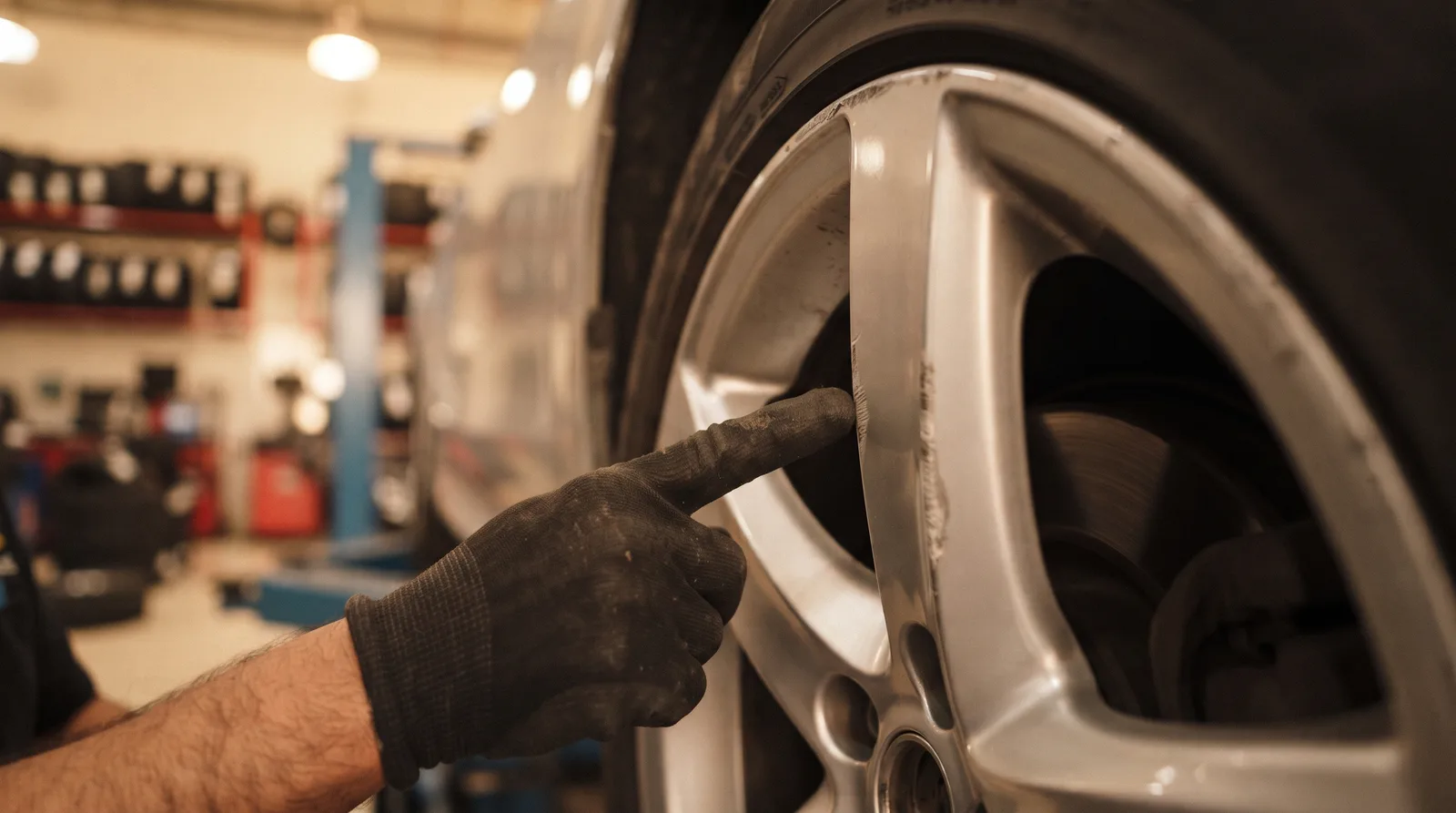
- Kerb rash is scuffing or gouging on the outer lip of the wheel, almost always from parking. It looks bad and is usually cosmetic.
- A bent wheel has had its lip or barrel pushed out of round, typically by a pothole, a speed bump taken too fast or a hard kerb strike. The bend is often on the inner side, where you cannot see it.
- A cracked wheel has a fracture in the lip, the barrel or a spoke. That is structural damage, and it is the one that matters most.
How to check your own wheels in five minutes
You need a phone torch and a few minutes in a shaded spot.
- The outer lip. Look at the edge of each wheel. Fine scratches and scuffed paint are rash. A gouge with metal missing, or a section of lip that looks flattened or pushed in, needs a closer look with the tyre off.
- The inner barrel of the front wheels. Turn the steering to full lock and shine the torch behind the spokes. Bends and cracks from potholes are often on the inside of the barrel, out of sight from the kerb side. Do the same on the other lock for the other front wheel.
- The spokes, especially where they meet the rim and the centre. Hairline cracks show up best when the wheel is clean.
- The tyre itself. The same blow that bends a wheel can damage the tyre's sidewall. A bulge or a cut is covered in our guide to sidewall bulges, cuts and cracks; a bulge means the tyre must be replaced.
Then pay attention to how the car behaves over the next week. These are the signs that a wheel is more than scuffed:
- A vibration that comes back after balancing. A wheel that has been balanced and still shakes at motorway speed is often not running true.
- A tyre that keeps losing air. If one tyre needs topping up every week or two and there is no nail in it, the tyre bead may not be sealing against a bent lip, or air may be escaping through a crack. A slow leak after a kerb strike is the clue most drivers miss.
- The steering wheel is no longer straight when you drive straight, or the car pulls. That is usually alignment knocked out by the same impact; our guide to alignment and balancing explains the difference.
- A tyre pressure warning for one wheel after the hit. Our guide to the tyre pressure warning light covers what to do.
Kerb rash: mostly cosmetic
Light scuffs on the outer lip do not affect the wheel's strength or the tyre's seal, so they are safe to drive on and can be refinished whenever you like. A painted wheel is sanded, filled and repainted. A diamond-cut wheel, the bright machined finish on many modern alloys, is skimmed on a lathe and lacquered again; each skim removes a thin layer of metal from the face, so a good refinisher will tell you if a wheel that has been cut before has enough material left.
Deeper damage is different. If a chunk is missing from the lip, or the edge has been pushed in, have the tyre removed and the wheel inspected before deciding it is cosmetic: what looks like a big scuff from the outside can be a bend on the inside.
Bent wheels: sometimes straightened, sometimes not
A small bend in the lip can often be straightened by a wheel specialist using hydraulic equipment, with the wheel then checked on a machine to make sure it runs true. Afterwards it should balance normally, run smoothly at motorway speed and hold its pressure for a week like the other three. If it does not do all three, the repair has not worked.
A bend in the barrel or close to the spokes, several bends on one wheel, or a bend that a repairer wants to heat to move, is a different matter. Alloy wheels are made from heat-treated aluminium alloy, and heating it changes the properties that give it its strength, in ways you cannot see from the outside. For those wheels, replacement is the safe answer.
Run-flat and low-profile tyres deserve a special mention. Their stiff or short sidewalls pass more of an impact straight to the wheel, and a wheel on run-flats can be bent without the driver noticing much at the time. If you drive on run-flats, our guide to run-flat tyres is worth reading alongside this one.
Cracked wheels: replace, do not weld
A crack is the one kind of damage with only one answer. It has already reduced the amount of metal carrying the load, and with every turn of the wheel it is flexed again, which is how cracks grow. Tyre makers' fitting instructions tell fitters never to mount a tyre on a damaged rim, and tyre and wheel makers' safety guidance warns against welding, heating or brazing a cracked or damaged rim. A welded wheel can look perfect and hold air, but nobody can tell you how strong it is.
When you replace a wheel, match it exactly: the same diameter, width, offset and load rating as the original, ideally the carmaker's own part number. A dealer or a wheel specialist can source it.
Prevention: the unexciting habits that work
- Park short of the kerb, not against it. Many cars can tilt the passenger mirror down when reversing; if yours can, switch it on.
- Take speed bumps slowly and brake before a pothole rather than in it, so the suspension is not compressed when the wheel hits the edge.
- Keep the pressure right. An under-inflated tyre squashes further on an impact and lets the rim get closer to the edge that hits it. Check cold against the door placard; our guide to tyre pressure in UAE heat explains how.
- Think twice about very large wheels. Each extra inch of wheel usually means less tyre sidewall to protect it; our guide to fitting bigger wheels covers the trade-offs.
- Fit rim protectors. These are a ring of tough nylon that sits between the tyre and the edge of the wheel, so a kerb scrape hits the ring instead of the alloy. They are fitted with the tyre deflated, so the easiest time is when new tyres go on. We stock AlloyGator protectors in packs of four for wheels up to 24 inches, in several colours. They are built for parking scrapes; they do not protect a wheel from a pothole.
Frequently asked questions
Can a cracked alloy wheel be welded?
It is not recommended. Tyre and wheel makers' safety guidance warns against welding or heating a cracked rim, because heat changes the strength of the aluminium alloy and nobody can measure the result by eye. Tyre fitters are told not to mount a tyre on a damaged rim. Replace a cracked wheel.
Is kerb rash dangerous?
Usually not. Scuffs on the outer lip are cosmetic and do not affect the wheel's strength or the tyre's seal. If metal is missing from the lip or the edge looks pushed in, have the wheel checked with the tyre off, because the damage may continue on the inside.
Why does my tyre keep losing air after I hit a kerb?
Either the tyre was damaged, or the wheel was. A bent lip can stop the tyre bead from sealing, and a crack can let air escape slowly. Have the tyre removed and both the tyre and the wheel inspected; topping up every week only hides the problem.
Do rim protectors really work?
For parking scrapes, yes: the protector ring sits proud of the wheel's edge, so the kerb touches it first. They do nothing against potholes or a hard kerb strike at speed, and they need to be fitted properly with the tyre deflated.
Do I need a wheel alignment after hitting a kerb?
If the steering wheel is no longer straight when driving straight, or the car pulls to one side on a flat road, yes. A hard kerb strike can move the alignment or bend a suspension part, and both show up as uneven tyre wear later; our guide to tyre wear patterns shows what to look for.
If any of this leaves you unsure about your own tyres, bring the car to your nearest branch and we will look with you - we have 8 across the UAE, the head office is on Al Nahda Street, Industrial Area 8, Sharjah, and we are open daily from 9:00 AM to 10:00 PM. You can also order on gcco.ae and choose mobile fitting at checkout, or message our team on WhatsApp at +971 800 525 - a real person will answer. Toll free 800 525.


