
Summer, All-Season or All-Weather Tyres: Which Type Actually Suits UAE Driving?

Ask three people in a UAE car park what kind of tyres they are driving on and you will probably get three different answers. The owner of an American-spec SUV will tell you it came on all-season tyres. The shop quoting for a new set talks about summer or touring tyres. And someone will be sure that all-season tyres last longer, so they must be the clever buy. None of them is exactly wrong, but the words mean different things depending on where a tyre was designed to be sold, and in our climate the difference matters more than most people think.
Here is what the season labels really mean, how to tell them apart on the sidewall, and the honest answer for a car that spends its life between Abu Dhabi, Dubai and the Northern Emirates.
Three families of tyre, divided by temperature
Tyre makers group car tyres by the conditions their rubber and tread are built for, and the dividing line is temperature.
- Summer tyres use a compound that keeps its grip in warm weather, with a tread made of larger blocks and fewer of the fine slits, called sipes, that winter tyres rely on. Despite the name they are not only sports tyres: most everyday touring and comfort tyres sold in warm countries are summer tyres too. Michelin describes them as designed for optimal performance above 7°C, on dry and on wet roads.
- Winter tyres use a much softer compound and a tread full of sipes that bite into snow and ice. They are built for the cold; in heat they wear quickly and feel vague. Nobody needs them on UAE roads.
- All-season tyres sit in between, giving up a little in warm weather to cope with cold, wet and light snow. Michelin is candid about the cost: above 7°C, even the best all-season tyres have a slightly longer braking distance, wet and dry, than summer tyres.
That 7°C figure appears again and again in tyre makers' advice. Below it, a summer compound starts to harden and lose grip; above it, the summer tyre is the better performer. Michelin's own rule of thumb is short: if temperatures rarely fall below 7°C and you never meet snow, summer tyres are the best option. The same page notes that summer tyres are particularly suited to places where temperatures often go above 35°C.
What that means on UAE roads
For the roads most of us drive every day, the temperature question answers itself. Even on a cool January morning on the coast, the air is well above 7°C, and from May to October a sunlit road surface gets much hotter than the air above it. That is summer-tyre territory for twelve months of the year.
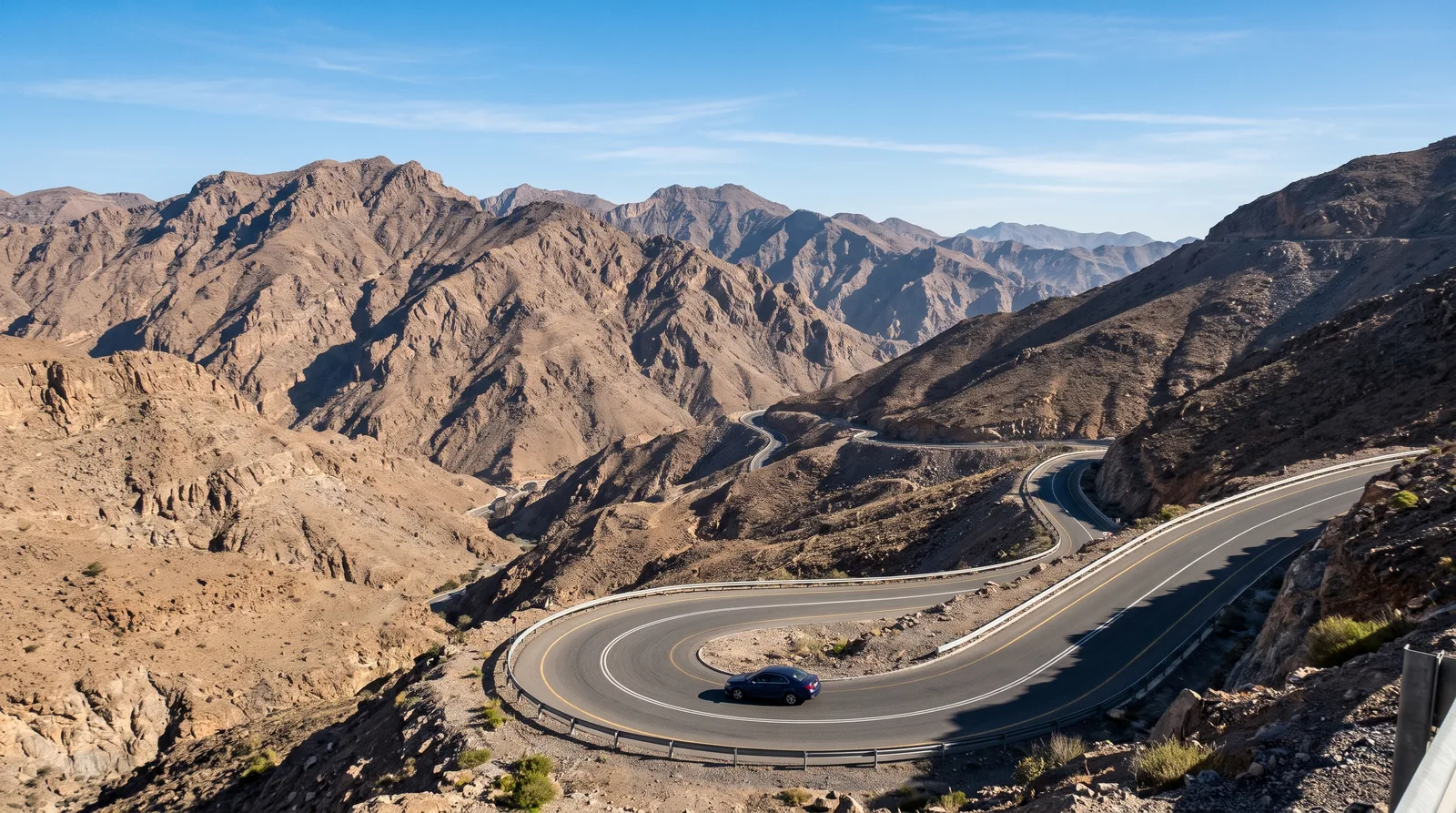
The only place the thermometer gets near the line is high in the mountains, where winter nights at the top of Jebel Jais can approach freezing. Even there, what would really change the choice of tyre is snow or ice on the road surface, and that is rare enough in the UAE to make the news when it happens. A summer tyre on a cold, dry mountain road is simply a little firmer than usual: drive the bends gently on an early-morning climb and it does the job.
So for nearly every car in the country, a summer or touring tyre is the right default, and that is what the market stocks. Of the 6,285 tyre listings on gcco.ae today, only 69 are classed as all-season.
Why so many UAE cars arrive on all-season tyres
If your car is on all-season tyres, it most likely came that way. Many cars built for the North American market leave the factory on all-season tyres, because they are sold into climates with real winters, and a fair number of those cars end up on UAE roads. The all-season tyres in our own catalogue tell the same story: they are mostly American-market SUV and pickup patterns, such as Michelin's LT A/S 2, Bridgestone's Alenza Sport A/S and Falken's Ziex ZE001 A/S.
There is nothing wrong with them. They are safe and legal, and in UAE heat they simply work at the warm end of the range they were designed for. The trade-off is the one Michelin describes: a slightly longer stop than an equivalent summer tyre when it matters, on a wet or a dry road.
When the time comes to replace them, you have a free choice between the same all-season model again or a summer or touring tyre in the same size, with the same load index and speed symbol. Two rules apply either way. Keep the same type across an axle, never one of each, for the reasons in our guide to mixing tyres. And on an all-wheel-drive car, keep all four the same. If the original tyres carry a carmaker approval code after the size, our guide to OE tyre markings explains whether it is worth keeping.
Reading the sidewall: M+S, the snowflake and "A/S"
The season of a tyre is not always written in plain words, and two of the markings are widely misunderstood.
M+S (also written M/S or M&S) stands for mud and snow. It is applied by the tyre maker on the basis of the tread design, and no snow test is required to use it. You will find it on many SUV tyres that are not all-season tyres in the European sense at all, including highway patterns such as the Pirelli Scorpion STR, which carries it in its name in our range. M+S on its own does not make a tyre a winter tyre, and it does not tell you much about how the tyre behaves in heat.
The three-peak mountain snowflake (often shortened to 3PMSF) is different: it means the tyre passed a standardised snow-traction test against a reference tyre. You will find it on winter tyres and on the European-style all-season tyres that some makers call all-weather. In several European countries that require winter tyres by law, this is the symbol that counts.
A/S, AS or All Season in a pattern name is the tyre maker telling you its intention. Whether that tyre is a mild American all-season or a snow-rated all-weather is shown by the snowflake symbol, not the name. Makers use "all-weather" differently from one market to the next, so trust the symbol over the marketing word.
What matters more than the season label in UAE heat
Once you have settled on summer or all-season, these decide far more about how a tyre treats you here:
- The right load index and speed symbol for your car, never lower than the placard. Our guide to speed and load ratings explains how to read them.
- Age. Heat ages rubber, and the date code on the sidewall tells you how old a tyre already is. See our guide to the DOT date code and the wider story in how the UAE summer destroys tyres.
- Pressure, checked cold against the door placard; our guide to tyre pressure in UAE heat explains why the forecourt reading misleads.
- The temperature grade on American tyres. Tyres made for the US market carry a UTQG code such as 500 A A. The final letter is the temperature grade, A, B or C, which rates the tyre's resistance to heat build-up at sustained speed; A is the highest. For long, fast motorway runs in July, it is worth a look.
- Wet grip. Rain is rare here, which is exactly why the first storm catches people out. Our guide to driving in UAE rain explains why tread depth matters, and our guide to the tyre label shows how to compare wet grip between two tyres.
When an all-season or all-weather tyre does make sense
There are a few honest cases for choosing a non-summer tyre while you live here:
- The car is moving abroad. If it is about to be shipped to Europe or North America, fit tyres for where it is going, not where it has been. In several European countries a snowflake-marked tyre is required in winter.
- A winter road trip into snow. Driving into a cold country in winter is the one situation where a summer tyre is the wrong tool. Check the rules of every country on the route before you leave.
- Replacing one or two tyres on an all-wheel-drive car that still has good all-season tyres on it. Matching the existing type, and ideally the same model, is better than mixing.
Outside those cases, a good summer or touring tyre in the correct size is the better match for a UAE car, and you are not giving anything up that you would ever use.
Frequently asked questions
Are all-season tyres bad in UAE heat?
No. They are safe and legal, and many imported cars run on them without trouble. Tyre makers say that above 7°C an all-season tyre stops in a slightly longer distance than an equivalent summer tyre, so when you replace them, a summer or touring tyre in the same size is the better match for this climate.
Do all-season tyres last longer than summer tyres?
Not as a rule. Tread life depends on the individual tyre model far more than on its season category, and some all-season tyres are made to last as long as summer tyres. Compare the specific tyres you are considering; on American-market tyres, the UTQG treadwear number gives a rough comparison between models from the same maker.
Can I mix summer and all-season tyres on my car?
Not on the same axle, because the two behave differently in braking and cornering. On an all-wheel-drive car, keep all four the same type. If you are fitting only two new tyres, our mixing-tyres guide explains which axle they go on.
Do I need winter tyres to drive up Jebel Jais?
No. Even on cold winter mornings the road is normally dry, and a summer tyre in good condition, at the correct pressure, is fine for the climb. Snow or ice on UAE roads is very rare; if you ever meet it, the safe choice is not to drive on it.
My SUV tyres say M+S. Are they all-season tyres?
Not necessarily. M+S is a tread-design marking that tyre makers apply without a snow test, and many highway SUV tyres carry it. Look for the three-peak mountain snowflake symbol, or for the season in the pattern name, to know what kind of tyre it really is.
If any of this leaves you unsure about your own tyres, bring the car to your nearest branch and we will look with you - we have 8 across the UAE, the head office is on Al Nahda Street, Industrial Area 8, Sharjah, and we are open daily from 9:00 AM to 10:00 PM. You can also order on gcco.ae and choose mobile fitting at checkout, or message our team on WhatsApp at +971 800 525 - a real person will answer. Toll free 800 525.


