
Why Are My Tyres So Loud? Finding the Source of the Noise and Choosing a Quieter Set

Some noises arrive suddenly. Tyre noise usually creeps up on you. The car that was quiet on the motorway last year now hums at 100 km/h, roars on certain stretches of road, or drones until you turn the radio up without noticing. By the time you do notice, it has been there for months.
The good news is that most of it can be explained, and much of it can be fixed or avoided next time. The first job is to be sure it is the tyres at all, because the same hum can come from a part that is about to cost you a lot more than a tyre.
Where tyre noise comes from
A rolling tyre makes noise in a few different ways at once:
- The tread hitting the road. Each tread block strikes the surface and leaves it again thousands of times a minute. Tyre designers vary the size of the blocks around the tyre so that the sound spreads across many pitches instead of one tone, but some of it always gets through.
- Air in the grooves. Air is squeezed out of the tread grooves as they meet the road and sucked back in as they leave, which adds a hiss and a roar.
- The air inside the tyre. The cavity of air in a tyre resonates like a drum when the tyre is struck, which you hear as a low boom over joints and rough patches.
- The road itself. Coarse surfaces and some kinds of concrete are much louder than smooth asphalt. If the noise changes the moment the surface changes, you are almost certainly hearing the tyres.
Is it really the tyres? Four checks
1. The surface test. Drive the same speed over different road surfaces. Tyre noise changes with the surface; most mechanical noise does not.
2. The coast test. On a clear, straight road where it is safe, hold a steady speed and then lift your foot off the accelerator. If the noise stays exactly the same as the car slows, it is coming from something that turns with the wheels - the tyres or the wheel bearings - rather than the engine or gearbox.
3. The bend test. On a long, gentle curve at a steady speed, listen for a change. A worn wheel bearing often gets louder when the car's weight leans on it in a bend and quieter when it leans the other way. Tyre noise usually changes much less with direction. A growl that comes and goes with the bends deserves a mechanic's attention soon, because a failing bearing gets worse.
4. Look at the tread and feel it. With the car parked, run your hand around the tread in both directions. Scalloped dips around the edge (cupping), or tread blocks that feel sharp one way and smooth the other (feathering), are uneven wear, and unevenly worn tyres are loud. Our guide to tyre wear patterns explains what causes each.
Some other noises are easy to blame on tyres but are not: a clicking from the front when turning on full lock is usually a driveshaft joint, a high squeal when braking is often the brake pads' wear indicator, and a rattle over bumps can be a loose heat shield. All of those are worth a workshop visit for their own sake.
Why tyres get louder over time
The main reason is uneven wear. A car that is out of alignment, or has tired shock absorbers, wears its tyres in patches, and those patches make noise. Once a tyre is cupped or feathered, that wear is permanent: correcting the alignment stops it getting worse, and regular rotation helps stop it developing in the first place, but neither makes a cupped tyre quiet again.
Age plays a part too. Rubber hardens as it ages, and heat speeds that up, so an old tyre can sound and feel harsher than it did when new. If your tyres are getting on, check the date code; our guide to tyre age explains how.
And sometimes the car has not changed at all, but you notice more. Electric cars are the clearest case: with no engine sound to cover it, tyre noise is much of what you hear at speed, which is one reason many EVs come from the factory on tyres with noise-reducing foam inside.
What makes a tyre quiet
- The type of tyre. Touring and comfort tyres are designed to be quiet; performance tyres trade some quietness for grip and steering response, and all-terrain tyres with big open blocks are louder on tarmac by design. Our guide to choosing a 4x4 tyre covers the SUV side of that trade-off.
- The size. Wider tyres with lower profiles tend to be noisier and firmer than narrower, taller ones on the same car.
- The measured noise figure. The tyre label gives a decibel figure measured the same way for every maker. Compare the numbers rather than the letters, and remember that every 3 dB more is twice the sound energy; our guide to the tyre label explains it.
- Noise-reducing foam. Some tyres have a layer of sound-absorbing foam bonded inside the tread, which damps the drum effect of the air cavity. Continental says its ContiSilent foam reduces parts of the rolling noise inside the car by up to 9 dB(A), and is clear that the effect depends on the car, the speed and the road. Each maker has its own name for it: on gcco.ae you can find tyres marked NCS, mostly from Pirelli and Bridgestone, tyres with Silent in the name, Michelin Acoustic, Continental ContiSilent and tyres marked Foam.
- Correct pressure. Run the tyres at the pressure on the door placard. Over-inflating them to make the car feel lighter makes the ride harsher, and an under-inflated tyre wears its shoulders and heats up; our guide to tyre pressure in UAE heat explains how to check.
Choosing a quieter replacement set
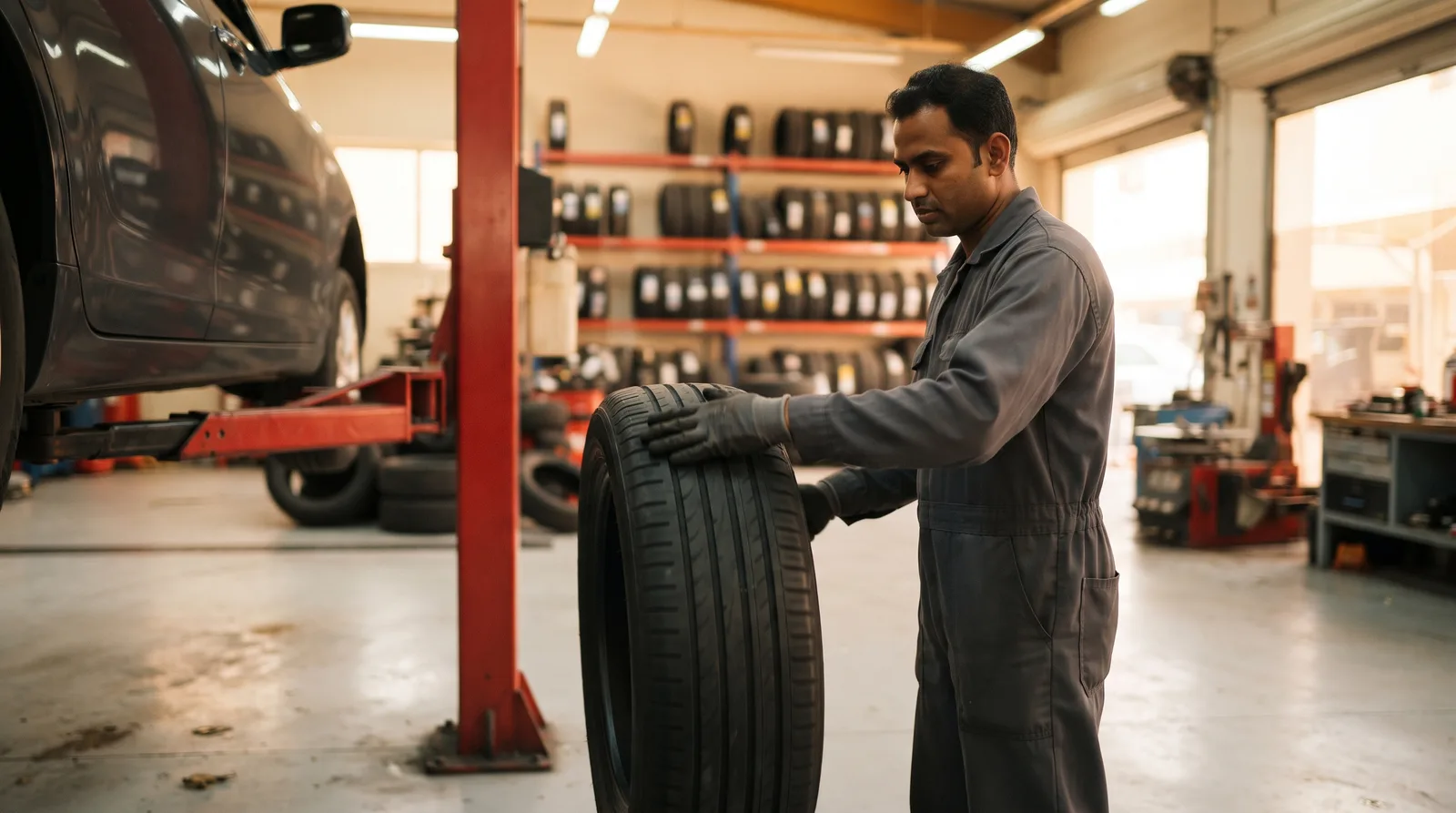
Start by fixing the cause. If the old tyres wore unevenly, have the alignment and suspension checked, or the new set will go the same way. Then choose a touring or comfort tyre in your size, compare the decibel figures of your shortlist, and if the car is an EV or a luxury car that came on foam-lined tyres, stay with a foam-lined replacement. Expect a new set to sound different from the old one for a while: full-depth tread and a new pattern have their own character, and the first few hundred kilometres also change how a tyre feels, as our first 500 km guide explains.
Frequently asked questions
Why are my new tyres louder than my old ones?
A different tread pattern, a different construction, or simply full-depth tread can all sound different from the worn set you took off. If the new tyres are much louder on every surface, or the noise comes with a vibration, have the balancing and fitting checked.
Do noise-reducing foam tyres really work?
They reduce the boom of the air inside the tyre, which is one part of the noise you hear in the cabin. Continental quotes up to 9 dB(A) for parts of the rolling noise with its ContiSilent foam, depending on the car, speed and road. They do not cancel tread or road noise, so the type of tyre still matters.
Is a humming noise always the tyres?
No. A worn wheel bearing makes a similar hum or growl that rises with speed. If the noise changes when the car leans in a bend, or does not change with the road surface, have the wheel bearings checked before you buy tyres.
Will rotation or an alignment make noisy tyres quiet?
Not if the noise comes from wear that has already happened. Alignment stops uneven wear getting worse, and rotation helps prevent it on the next set, but a cupped or feathered tyre stays noisy until it is replaced.
Are all-terrain tyres always loud?
They are louder on tarmac than highway tyres, because their big blocks and wide gaps are built for sand and rock. Some are much quieter than others, so if most of your driving is on the road, compare noise figures, or consider whether a highway-terrain tyre suits you better; our guide to all-terrain or highway tyres helps you decide.
If any of this leaves you unsure about your own tyres, bring the car to your nearest branch and we will look with you - we have 8 across the UAE, the head office is on Al Nahda Street, Industrial Area 8, Sharjah, and we are open daily from 9:00 AM to 10:00 PM. You can also order on gcco.ae and choose mobile fitting at checkout, or message our team on WhatsApp at +971 800 525 - a real person will answer. Toll free 800 525.


