
Directional and Asymmetric Tyres: What the Arrow and the OUTSIDE Mark Mean

You collect the car after new tyres, a rotation or a puncture repair, pay, and drive away. Most people never look at the tyres again. Yet two kinds of tyre can be fitted the wrong way round, nothing on the dashboard will ever tell you, and the check takes about a minute in your own parking space.
This guide explains the three kinds of tread pattern, the marks on the sidewall that go with them, how to check your own car, and what to do if you find one facing the wrong way.
Three kinds of tread pattern
- Symmetric. The inner and outer halves of the tread are the same, so the tyre can be fitted either way round and on any corner of the car. Continental describes symmetric patterns as giving smooth driving, high directional stability and low rolling resistance, and Uniroyal calls them particularly quiet.
- Directional. The tread forms a V or arrow shape pointing one way. Continental's definition is short: a tyre designed to roll forward in one direction only. The shape is there to push water out from under the tyre; Uniroyal describes it as a chevron pattern that aids fast water displacement.
- Asymmetric. The inner and outer halves are different, each with its own job. In Continental's description the inner part of the tread is responsible for moving water and protecting against aquaplaning, while the outer part has rigid tread blocks that give stiffness in corners.
A few tyres are both asymmetric and directional. Those, as BFGoodrich puts it, require left and right specific tyres: a tyre made for the left side of the car cannot be used on the right.
The marks on the sidewall
You do not have to recognise a pattern by eye, because tyres that must face a particular way say so.
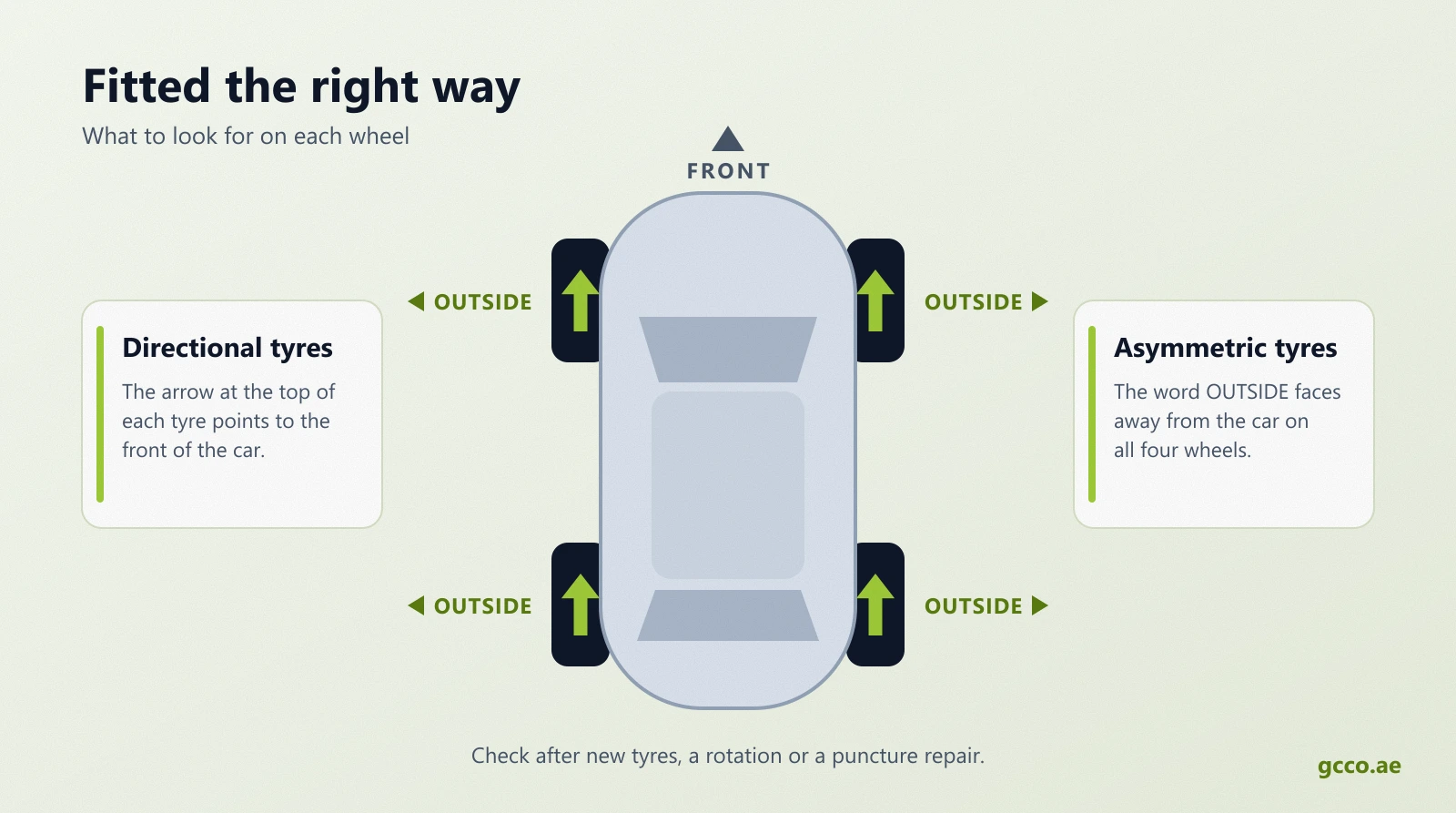
- Directional tyres carry an arrow on the sidewall, often beside a word such as ROTATION, pointing in the direction the tyre must turn when the car moves forward.
- Asymmetric tyres carry the word OUTSIDE on the face that must point away from the car, and usually INSIDE on the other face.
- Symmetric tyres have neither mark.
The one-minute check
- Find the arrow, if there is one. Look at the part of the sidewall at the top of the wheel. The arrow there should point towards the front of the car. Check all four.
- Find OUTSIDE, if it is there. It should be on the face you can read while standing beside the car, on all four tyres. If you can read INSIDE from where you stand, that tyre is on inside out.
- No arrow and no OUTSIDE? The tyres are symmetric and there is nothing to get wrong.
The moments to check are after new tyres, after a rotation, after a puncture repair where the tyre came off the wheel, and after the spare has been used.
What happens if one is on the wrong way
The car will still drive, and nothing on the dashboard will tell you, which is how a reversed tyre can go unnoticed for a long time. What you lose is what the pattern was designed to do. Continental says of a directional tread oriented the wrong way that this would render the benefits of the tread useless, and of asymmetric tyres that the side marked "outside" must be on the outside of the car for the tread to achieve its optimal effect.
Moving water is the whole job of a directional pattern and half the job of an asymmetric one, so a wet road is where the loss shows. Rain is rare here, and the day it comes is the day you find out; our guide to driving in UAE rain explains what aquaplaning is.
How urgent is it? Continental allows one exception to its fitting rule, the short-term use of a spare, and says drivers should go back to the correct position at the earliest opportunity. That is a sensible guide for any wrongly fitted tyre: drive gently, take extra care in the wet, and have it put right soon. The tyre has to come off the wheel, be turned and be rebalanced, which is a small job for any tyre shop.
Rotation: which way each type can move
- Directional tyres move front to back on the same side of the car. Continental and Pirelli both give the front-to-rear pattern for them, and Bridgestone's manual explains why: the direction of revolution must not change. Moving one to the other side means taking it off the wheel and turning it round.
- Asymmetric tyres keep their OUTSIDE on the outside whichever side of the car the wheel is on, so many of them can change sides. Makers are not unanimous: Uniroyal says its asymmetric tyres work on either side of the car, while Continental's guidance gives front-to-back rotation only. Follow your car's handbook.
- Symmetric tyres can go anywhere.
Our guide to tyre rotation has the patterns for front-, rear- and four-wheel drive. With tyres bought from us, rotation every 10,000 km is free.
The spare, and the odd one out
A full-size spare with a directional tyre is only right for one side of the car, so half the time it will be turning backwards when you fit it. That is the exception Continental allows: use it to get to a tyre shop, then put things back as they should be. Our guide to your spare tyre covers the other limits.
Do not mix pattern types on the same axle. Continental warns that mixing patterns impairs a car's handling and could even be dangerous, and Michelin's advice is that the two tyres on an axle should be the same model. Our guide to mixing tyres covers what to do when you are replacing only two.
Should you pick one type over another?
Not on the pattern alone. The tread pattern is one part of a tyre's design, together with its compound and construction, and two tyres of the same type can perform very differently. Choose the right size and ratings first, then compare measured figures; our guide to the tyre label shows how to compare wet grip and noise between two tyres. What matters afterwards is that whatever you buy is fitted the way its maker intended.
Frequently asked questions
How do I know if my tyres are directional?
Look for an arrow on the sidewall, often beside the word ROTATION. The tread itself usually forms a V shape. If there is no arrow, the tyre is not directional.
What happens if a directional tyre is fitted backwards?
The car still drives, but the tread cannot do what it was designed to do. Continental says the benefits of the tread are lost when the pattern faces the wrong way, and the loss matters most on a wet road. Have the tyre turned on its wheel at the earliest opportunity.
Does OUTSIDE have to face outwards on the rear tyres too?
Yes. On an asymmetric tyre the side marked OUTSIDE must face away from the car at all four corners.
Can asymmetric tyres be swapped from one side of the car to the other?
Often, yes, because the outside face stays on the outside whichever side the wheel is on. Makers differ, and a tyre that is both asymmetric and directional cannot change sides, so check for an arrow and follow the handbook.
Can I use a directional spare on the wrong side?
For a short time, to reach a tyre shop. Continental names the short-term use of a spare as the only exception to its fitting rule and says to return to the correct position at the earliest opportunity.
If any of this leaves you unsure about your own tyres, bring the car to your nearest branch and we will look with you - we have 8 across the UAE, the head office is on Al Nahda Street, Industrial Area 8, Sharjah, and we are open daily from 9:00 AM to 10:00 PM. You can also order on gcco.ae and choose mobile fitting at checkout, or message our team on WhatsApp at +971 800 525 - a real person will answer. Toll free 800 525.


