
Tyre Wear Gets a Legal Limit: What Europe's New Rules Mean for the Tyres You Will Buy From 2027

Tyres wear out. Everybody knows that; what almost nobody asks is where the rubber goes. The answer is that it is left on the road, a few grams at a time, and for the first time a legal limit is being put on how much of it a tyre may shed. The rule is European, the first deadline for car tyres falls in 2028, and the last missing piece of it, the number itself, is due to be written into European law during 2027.
The UAE is not part of that rule. But more than 800 of the tyre listings on gcco.ae today are made in European factories, and many of the patterns sold here are the same ones sold in Europe. The next generation of tyres on UAE shelves will be shaped by it. Here is what has been decided, what has not, and what it means for someone buying tyres here.
The short version
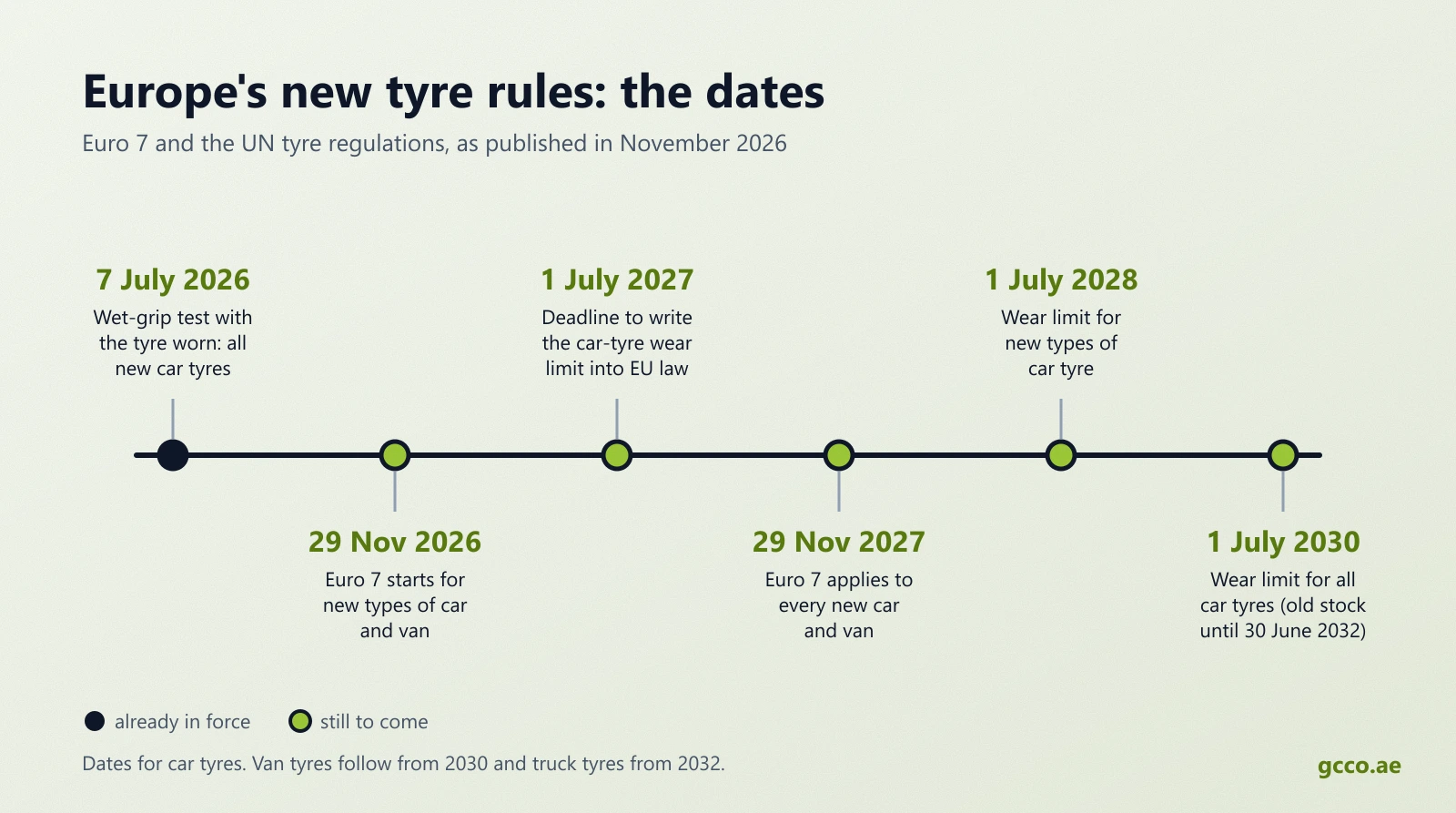
- Euro 7, the European Union's new vehicle emissions standard, applies to new types of car and van from 29 November 2026 and to every new car and van from 29 November 2027.
- It reaches beyond the exhaust pipe for the first time, to particles from brakes and rubber worn from tyres.
- Tyre wear limits apply to new types of car tyre from 1 July 2028 and to every car tyre placed on the European market from 1 July 2030. Stock that does not comply may be sold until 30 June 2032.
- Van and truck tyres follow: new types of van tyre from 1 April 2030 and of truck tyre from 1 April 2032.
- A second rule has already arrived. Since 7 July 2026 the European approval for a car tyre includes a wet-grip test with the tyre worn, not only when it is new.
How do you measure tyre wear?
The method was agreed at the United Nations forum that harmonises vehicle regulations. In June 2026 it voted through a new UN regulation on tyre abrasion, with 37 votes in favour, none against and two abstentions. At the time of writing, its formal entry into force is still pending.
The test compares a tyre with a standard reference tyre. Both are run under the same conditions, either on cars driving in convoy on public roads or on a drum indoors, and the rubber each one loses is weighed and expressed in milligrams per kilometre for each tonne of load. Divide one figure by the other and you have an abrasion index. For an ordinary car tyre the index must not be higher than 1.00, with small allowances for certain kinds of tyre, such as reinforced (XL) tyres and very low-profile, high-speed sizes. A tighter second stage is written in from 2033.
One piece is still missing on the European side. The Euro 7 regulation leaves its own table of tyre limits empty and obliges the European Commission to fill it, for car tyres, by 1 July 2027. That is the date to watch next year.
How much do tyres differ?
More than you might guess. The German motoring club ADAC measured almost 100 tyres and found that a car sheds about 120 grams of tyre for every 1,000 km on average, all four tyres together. The best tyre it tested lost 59 grams and the worst about 171, close to three times as much.
ADAC also makes the point that matters to a buyer. Low abrasion, it says, "not only protects the environment, but also the motorist's wallet as the tyres last longer with the same new tread depth". A tyre that keeps its rubber is, other things being equal, a tyre you replace later.
What the tyre makers say
Michelin says it will be ready to apply the Euro 7 rule as early as 2028, and it has pressed regulators on the test itself: by its own figures, one tyre could score 1.42 on the road and 0.83 in the laboratory, failing by one method and passing by the other. Continental points at the driver, saying that driving style affects tyre abrasion three times more than tyre design does. The industry's association, Tyres Europe, has asked for rules that can be enforced in practice as well as being ambitious.
The rule that has already arrived: worn tyres in the wet
Until recently a tyre's wet grip was tested for approval only when it was new. That changed in two steps: new types of car tyre from 7 July 2024, and all of them from 7 July 2026, must also pass a wet-grip test in the worn state. Tyres made before the 2026 date under the older approval may still be fitted in Europe until 6 January 2029.
It matters outside Europe too, because it changes what a tyre maker has to design for: grip that holds up as the tread wears down, not only a tyre that tests well on its first day. It does not change the advice in our guide to driving in UAE rain. Tread depth still decides how much water a tyre can clear.
Will the tyre label show wear?
Not yet. The European tyre label grades fuel efficiency, wet grip and noise, and the law behind it allows wear and mileage to be added once reliable test methods exist. In a report in June 2026 the European Commission said that labelling for abrasion and mileage had been delayed by the absence of standardised test methods, and that the work at UN level may yield solutions by 2027. No date has been set. Our guide to the tyre label explains what it shows today.
Two more rules that reach the tyre shelf
- Brake dust. Euro 7 also limits the particles that brakes give off: 7 milligrams per kilometre for most new cars and 3 for pure electric ones, in a first stage that runs to the end of 2029.
- Natural rubber. The European Union's deforestation regulation covers rubber, and tyres are on its list of products. After two postponements it applies from 30 December 2026 to medium and large companies and from 30 June 2027 to micro and small ones. Makers selling in Europe have to trace the rubber they use back to where it was grown.
Does any of this apply in the UAE?
Not directly. These are European rules for tyres sold in Europe. We found no announced change to Gulf tyre standards: the GCC Standardization Organization's list of technical regulations for 2027 model-year vehicles still cites its long-standing tyre standards. The rules that apply to your tyres here are the ones in our guide to the UAE tyre rules: tread depth, age and condition.
Indirectly, it reaches us through the tyres themselves. Many of the patterns on sale here are the same ones sold in Europe, so when a maker redesigns one to meet a European limit, that is likely to be the tyre that arrives here too.
What it means when you buy tyres here
- Nothing you own becomes illegal. The limits are for tyres sold in Europe, and they are phased in over several years.
- Do not wait for it. If your tyres are worn, old or damaged, the time to replace them is now; our guide to when to replace your tyres lists the signs.
- Expect new generations of familiar names. The big makers are already renewing their main lines; our round-up of new tyres for 2027 covers what has been launched.
- Expect wear to become a figure you can compare. Until it is, use what is already measured: the label grades for your exact size.
- Your own share is the largest. If driving style counts for three times as much as design, then smooth driving, correct pressures, a straight alignment and regular rotation do more for tyre life than any regulation. With tyres bought from us, rotation every 10,000 km is free.
Frequently asked questions
Will my current tyres become illegal because of Euro 7?
No. The tyre wear limits are a European rule for tyres placed on the European market, starting with new tyre types in July 2028. They do not apply to tyres already on your car, and they are not a UAE rule.
When do the tyre wear limits start?
For car tyres, 1 July 2028 for new types and 1 July 2030 for all tyres placed on the European market, with older stock allowed on sale until 30 June 2032. Van tyres follow from 1 April 2030 and truck tyres from 1 April 2032.
Does a low-wear tyre last longer?
Generally, yes. ADAC, which has measured tyre wear on a large number of tyres, says tyres with low abrasion last longer given the same tread depth when new. How long your own tyres last still depends heavily on pressure, alignment and how you drive.
Will tyre labels show how fast a tyre wears?
Not yet. European law allows wear and mileage to be added to the tyre label once reliable test methods exist, and the European Commission said in June 2026 that the work is not finished. No date has been set.
Is there a tyre wear limit in the UAE?
We found no such rule. The UAE's tyre rules concern tread depth, age and condition, and at the time of writing no change to Gulf tyre standards has been announced for 2027.
If any of this leaves you unsure about your own tyres, bring the car to your nearest branch and we will look with you - we have 8 across the UAE, the head office is on Al Nahda Street, Industrial Area 8, Sharjah, and we are open daily from 9:00 AM to 10:00 PM. You can also order on gcco.ae and choose mobile fitting at checkout, or message our team on WhatsApp at +971 800 525 - a real person will answer. Toll free 800 525.


