
Tyre Blowout at 120 km/h: What to Do in the First Ten Seconds, and How to Avoid One

It starts with a bang, or sometimes only a dull thump, and then the car is not the car you were driving a second ago. The steering tugs to one side or the back end begins to sway, there is a flapping noise from one corner, and every instinct you have says the same thing: brake, now.
That instinct is the one to resist. A car with a burst tyre can usually be brought to a safe stop by a driver who keeps it straight and lets it slow down. What turns a blowout into a crash is hard braking or a snatch at the steering wheel. Here is what tyre makers tell drivers to do, where their advice differs, and what makes a blowout far less likely in the first place.
What a blowout feels like
Michelin describes the two cases. If a front tyre goes, the car pulls sharply towards the side of the failed tyre and the steering feels heavy. If a rear tyre goes, the back of the car becomes unstable and starts to fishtail. Either way there is noise and vibration from the damaged corner, and either way the car still has three good tyres and can be steered.
The first ten seconds
- Hold the steering wheel firmly with both hands and keep the car pointing straight down your lane. Expect the pull and steer gently against it. Do not swerve.
- Do not brake hard. Bridgestone's safety manual puts it in capital letters: do not abruptly brake or turn. Sudden braking makes a car with one failed tyre much harder to keep straight.
- Do not snap your foot off the accelerator either. Come off it gradually and let the drag of the failed tyre slow the car.
- Let the speed fall on its own. Once the car has slowed and is running straight, brake gently. Michelin's guidance is to wait until you are below about 50 km/h.
- Signal and move onto the hard shoulder, as far from the traffic lane as you can get, and switch on the hazard lights.
Where the experts differ: the accelerator
Read more than one tyre maker's advice and you will notice that they do not agree about the accelerator. Bridgestone says to take your foot off it slowly. Michelin says to keep your foot on it briefly, to maintain momentum and stabilise the car, and then ease off gradually. The UK's Highway Code does not mention the pedals at all: grip the steering wheel firmly and allow the vehicle to roll to a stop at the side of the road.
The difference is smaller than it sounds. Nobody tells you to brake, and nobody tells you to lift off suddenly. Whether you hold the pedal for a second or begin to ease off straight away, the common ground is the same: steady hands, no sudden movements, and a gradual loss of speed.
Once you have stopped
- Get the whole car onto the shoulder, as far from the live lane as possible, and keep the hazard lights on.
- Get everyone out on the side away from the traffic and well clear of the car, behind the barrier if there is one.
- Do not change a wheel with traffic passing your elbow. If you cannot work well away from the lane, call for roadside assistance instead.
- Do not expect to save the tyre. Michelin notes that running a tyre flat, even for a short distance, typically damages it beyond repair.
- Have the wheel checked as well. Bridgestone's manual says a bent or cracked wheel must be replaced, so a wheel that has been driven on with a failed tyre should be inspected before a new tyre goes on it. Our guide to alloy wheel damage explains what a fitter looks for.
- Remember what your spare is. A space-saver has its own speed and distance limits; our guide to your spare tyre covers them.
Why tyres burst
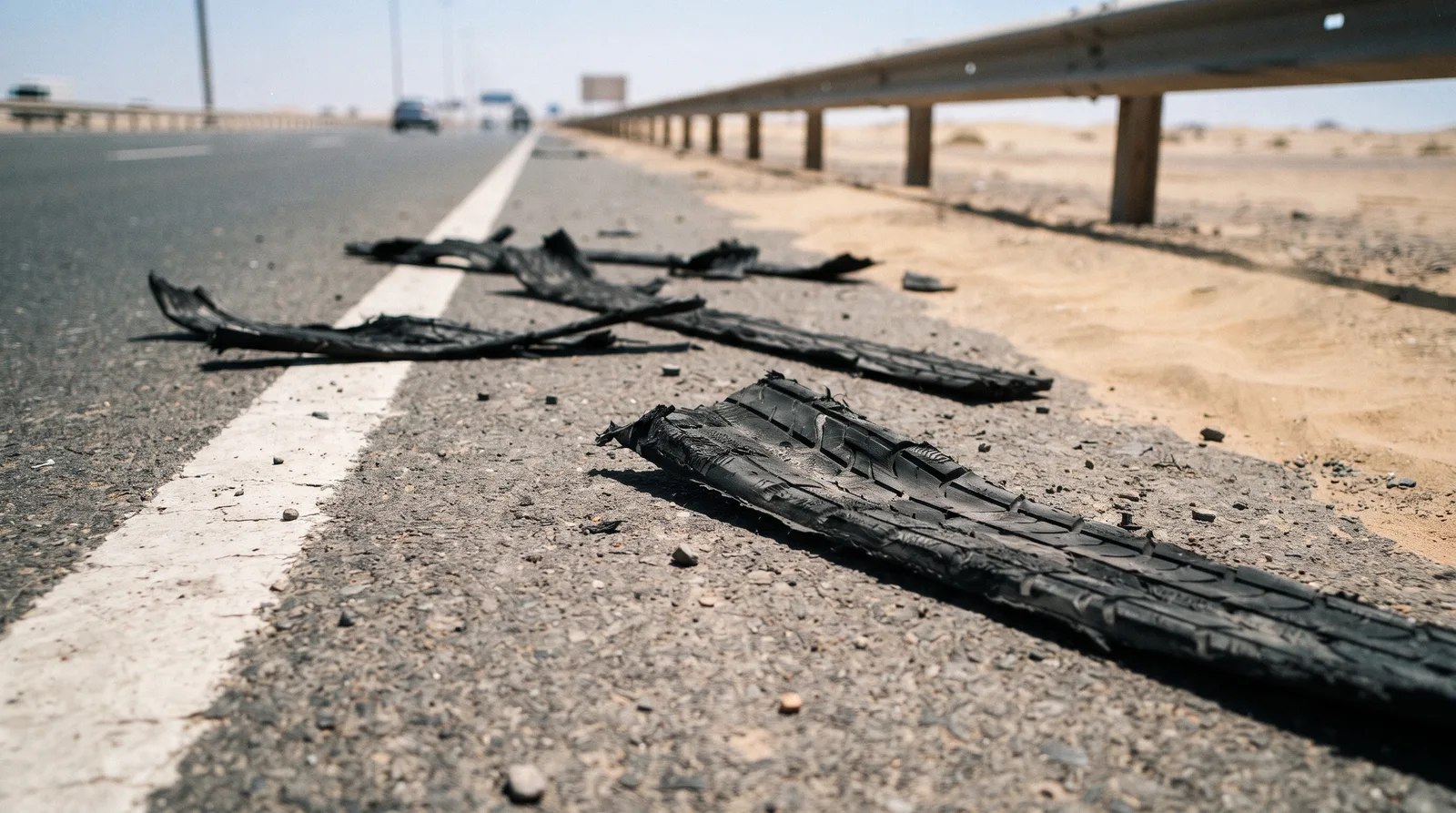
A blowout is rarely plain bad luck. Michelin lists the most common causes as sustained under-inflation, overloading, impact damage and damage that was already there.
- Under-inflation is the big one. A soft tyre flexes more on every turn of the wheel, and Bridgestone's manual states the result plainly: under-inflation causes excessive heat build-up and internal structural damage. Add a July road surface and a long, fast run, and the tyre comes apart from the inside. Our guides to tyre pressure in UAE heat and how the summer destroys tyres explain the mechanism.
- Overloading does the same job from the other direction: more weight than the tyre is inflated to carry. Our guide to a fully loaded car explains the full-load pressures on your door placard.
- Impact damage. Bridgestone warns that a damaged tyre may show no visible sign of harm and still fail suddenly a day, a week or even months later. A hard pothole or kerb strike deserves a proper look; our guide to sidewall bulges, cuts and cracks shows what to look for.
- Bad repairs. The same manual calls driving on an improperly repaired tyre dangerous, because it too can fail suddenly. Our puncture repair guide explains what a proper repair is.
- Age. Rubber hardens and cracks as it ages, faster in heat, and the UAE inspection fails tyres more than five years old; see our guide to the DOT date code.
The numbers are small, but they are real. The Ministry of Interior counted 65 accidents caused by tyre blowouts on UAE roads between 2023 and 2025, The National reported in August 2026, and the police repeat the warning every summer. Driving on unfit tyres also carries a fine, black points and impoundment, as our guide to the UAE tyre rules explains.
How to make a blowout unlikely
- Check the pressures cold every month and before any long drive, against the door placard, and use the full-load figures when the car is full.
- Do not drive on with the pressure warning light on. It is telling you about the most common cause of a blowout while there is still time to act; our guide to the tyre pressure warning light explains what to do.
- Look at the sidewalls after any hard hit, and every few weeks in any case.
- Know how old your tyres are, including the spare.
- Have punctures repaired properly, from the inside, or not at all.
- Before a long trip, run through our road-trip tyre checklist.
If your car is on run-flat tyres, a loss of pressure is less dramatic: Continental says you can continue for 80 km at up to 80 km/h after a puncture, and Bridgestone adds that the real distance may be less or more depending on the conditions. Run-flats need the same pressure checks as any other tyre, and our guide to run-flat tyres explains their limits.
Frequently asked questions
Should I brake when a tyre bursts?
Not at first. Tyre makers agree that hard braking is the wrong reaction, because it makes the car harder to keep straight. Hold the wheel, let the car slow down gradually, and brake gently only once the speed has dropped and the car is running straight.
Should I accelerate during a blowout?
Makers differ. Michelin says to keep your foot on the accelerator briefly to steady the car and then ease off; Bridgestone says to take your foot off slowly. Neither tells you to brake or to lift off suddenly, and that shared point is the one to remember.
Is a front or a rear blowout worse?
They feel different. Michelin describes a front blowout as a sharp pull towards the failed tyre with heavy steering, and a rear blowout as the back of the car becoming unstable and fishtailing. The response is the same for both: hold the wheel straight, stay off the brake and let the car slow.
Can a burst tyre be repaired?
No. A tyre that has burst, or that has been driven on while flat, is finished. Have the wheel inspected too, because a bent or cracked wheel must be replaced before a new tyre is fitted to it.
Will the tyre pressure warning light warn me before a blowout?
Often, yes, because the commonest cause is a tyre that has been running soft, and that is exactly what the light detects. It cannot warn you about hidden impact damage or an old tyre, which is why the visual checks still matter.
If any of this leaves you unsure about your own tyres, bring the car to your nearest branch and we will look with you - we have 8 across the UAE, the head office is on Al Nahda Street, Industrial Area 8, Sharjah, and we are open daily from 9:00 AM to 10:00 PM. You can also order on gcco.ae and choose mobile fitting at checkout, or message our team on WhatsApp at +971 800 525 - a real person will answer. Toll free 800 525.


