
Wadi and Mountain Tracks in the UAE: Tyres, Pressure and the Rain Rule

When the weather cools, the mountains open up. The tracks of the Hajar range, through the wadis of Ras Al Khaimah, Fujairah and the Hatta area, are some of the best driving in the country, and very different from the dunes. Sand is soft and forgiving. Rock is not: it is sharp, it does not move out of the way, and it finds the weakest part of a tyre. Here is what changes for your tyres, and the one rule that matters more than any of them.
The rain rule comes first
A dry wadi is a riverbed, and when it rains it becomes one again. On 19 November the National Centre of Meteorology issued a flash-flood alert for the mountainous regions of Fujairah, with a yellow rain alert for Fujairah, Ras Al Khaimah and parts of Al Ain, as The National reported, and Abu Dhabi Police told drivers to exercise caution and follow the changing speed limits shown on electronic boards. Earlier in the month the Ministry of Interior told drivers to slow down and keep a safe distance in rain, and to keep away from wadis.
That makes the first decision easy: if rain is forecast for the mountains, do not drive the wadis that day. No tyre makes a flooded riverbed safe.
On rock, keep the pressure up
Lowering pressure is the standard trick for sand, because it lengthens the footprint so the tyre floats. On rock and gravel tyre makers are more cautious. BFGoodrich says that "in most conditions, your vehicle can be driven off-road at the same pressures used on paved roads", and that reducing pressure slightly helps in low-traction conditions, giving sand as its example. It also warns that reducing pressure "without reducing load or speed will lead to excessive heat build-up", and that pressures below 1.5 bar should only be used off-road at 20 km/h or less.
The practical reading for mountain tracks: start at your normal road pressure, which keeps the sidewall firmer and less exposed to sharp edges. If you meet soft sand in a wadi bed and need more grip, BFGoodrich's advice is to lower pressure gradually, 0.5 bar at a time, and Jeep's manual adds that you should only reduce pressure if you have a way to put the air back, which means a compressor in the car. Then reinflate before the road home.
What sharp stones do to a tyre
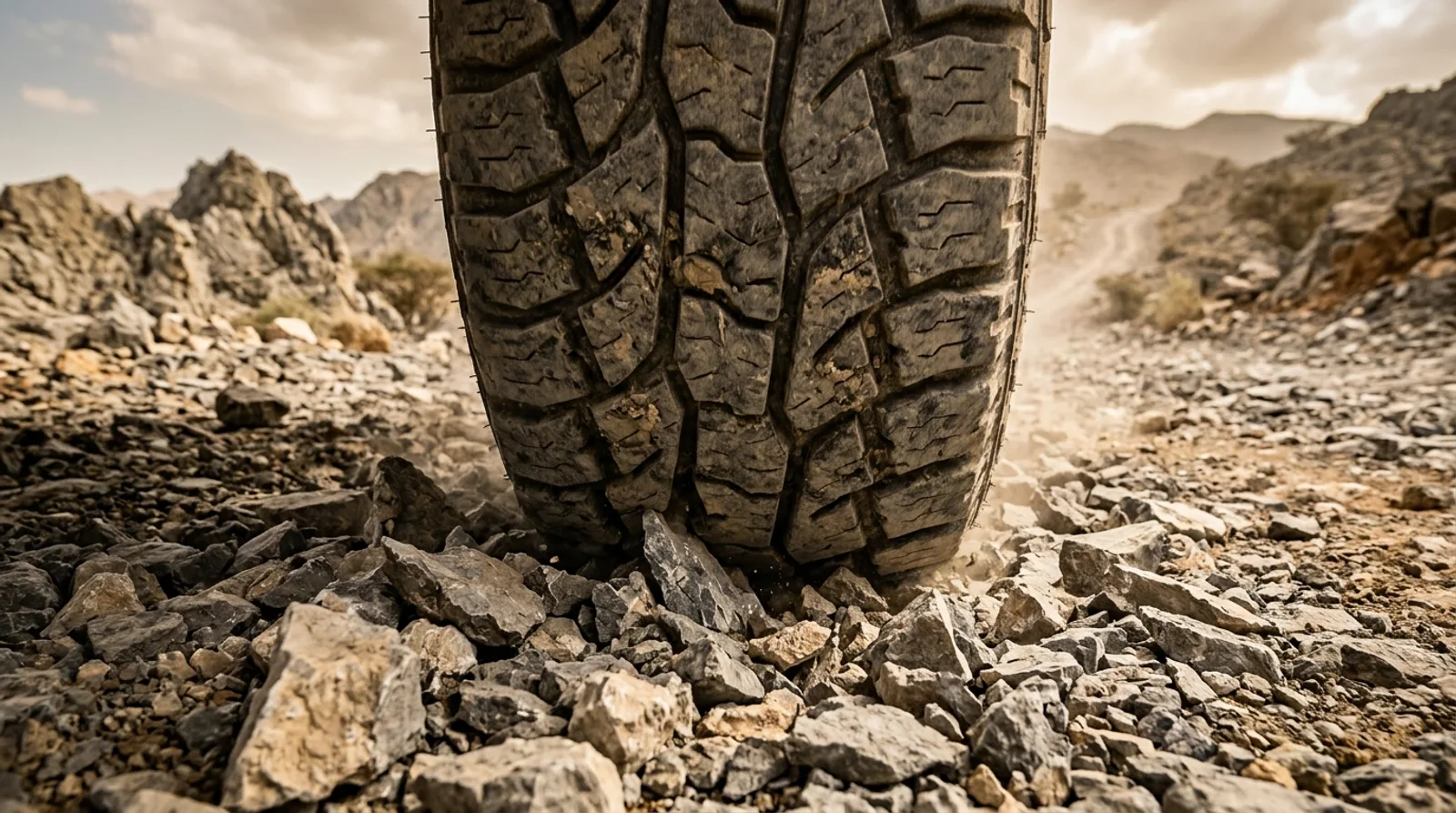
The common mountain-track failure is not a puncture in the tread but a cut in the sidewall from a sharp edge of limestone or a buried rock. Michelin's Middle East advice is to have your tyres checked after driving over sharp stones, and it is blunt about sidewalls: if one is punctured or cut, "it is impossible to repair the tyre". Three habits reduce the risk:
- Drive slowly over sharp ground. The harder a tyre strikes an edge, the more likely it is to cut.
- Place the tread, not the sidewall, on sharp rocks, and avoid scraping along rock walls or ledges.
- Carry a full-size spare that matches the other four, at the right pressure. A cut sidewall a long way up a track is when you will need it; our spare tyre guide explains why a space-saver is not ideal here.
Tyres for the tracks
A highway tyre will cope with graded gravel roads driven sensibly. For regular rocky tracks, an all-terrain tyre's tougher construction is worth having. In our range, the Landspider Wildtraxx A/T, from Landspider, one of the two brands we distribute, comes in many 4x4 and pickup sizes, and for owners who go further off the road Landspider describes its Wildtraxx M/T as having three body plies and an anti-cutting compound; our guide to the 4x4 tyre ladder quotes the details. Browse our Wildtraxx range or the full off-road tyre range. For the many SUVs that only see a mountain road on the way to a viewpoint, the Laufenn X FIT HT, with stone ejectors and a construction Laufenn says resists stone damage, is the comfortable highway choice.
Before and after the trip
- Check pressures cold before you leave, against the door placard.
- Look at the tread depth and the date codes; tyres older than five years fail the UAE vehicle test, and old rubber cuts more easily.
- Travel with a second vehicle on remote tracks if you can, and carry water, a compressor, a gauge and a tyre repair kit.
- Afterwards, walk round every sidewall; our after-trip tyre and wheel check lists what to look for.
Frequently asked questions
Should I let my tyres down for wadi and mountain tracks?
Usually not. BFGoodrich says most off-road conditions can be driven at normal road pressure, and keeping the pressure up keeps the sidewall firmer on sharp rock. Lower it gradually only if you meet soft sand, and reinflate before the road.
Can a tyre with a cut sidewall be repaired?
No. Michelin says a punctured or cut sidewall cannot be repaired, so the tyre must be replaced. Fit the spare and drive out carefully.
Is it safe to drive in a wadi when it rains?
No. The Ministry of Interior tells drivers to keep away from wadis in rain, and the National Centre of Meteorology issues flash-flood alerts for the mountain areas. Cancel the trip if rain is forecast.
Do I need all-terrain tyres for the Hajar mountains?
For graded roads to viewpoints, no. For regular rocky tracks, an all-terrain tyre's tougher construction makes cuts less likely and is worth the extra road noise.
If any of this leaves you unsure about your own tyres, bring the car to your nearest branch and we will look with you - we have 8 across the UAE, the head office is on Al Nahda Street, Industrial Area 8, Sharjah, and we are open daily from 9:00 AM to 10:00 PM. You can also order on gcco.ae and choose mobile fitting at checkout, or message our team on WhatsApp at +971 800 525 - a real person will answer. Toll free 800 525.


